Objective
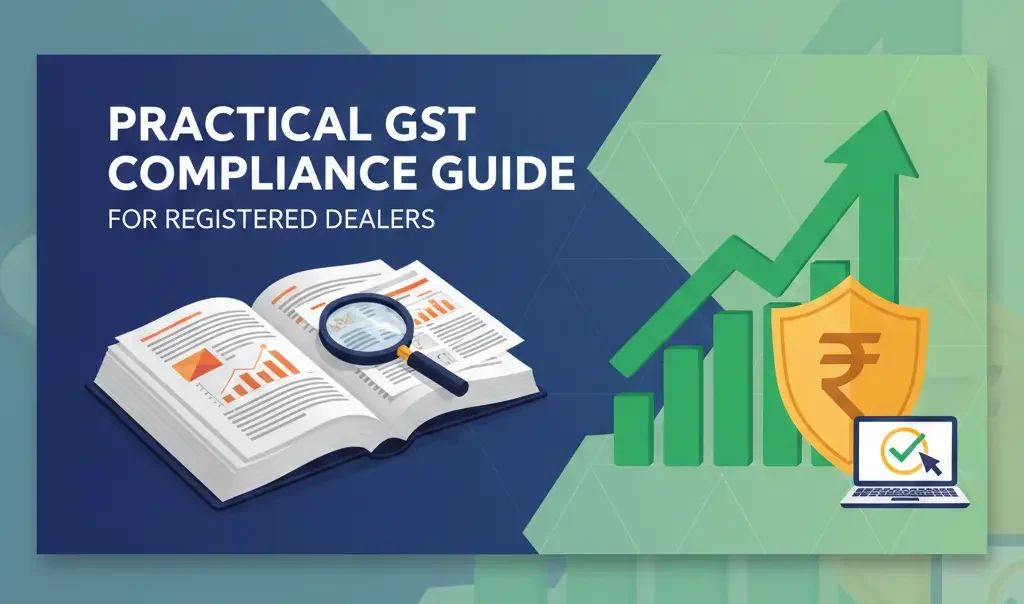
This note provides simple, concise and practical GST guidelines highlighting the common things to take care of by the registered dealers in day-to-day operations and the basic precautions one should follow. It is intended as a general guideline useful for the dealers across various business dealing in supply of goods and/ or services.
1. Time of Supply
a. For goods: Upon issuance of the tax invoice- before or at the time of delivery or removal.
b. For Services: To issue the invoice within the 30 days from the date of supply (ie. completion of the service).
c. Advance received on supply of services are also subject to GST at the time of receipt.
Relevance/ Conclusion Note:
The liability to pay GST on outward supply is determined based on time of supply. Correct determination of time of supply ensures that tax is paid in appropriate tax period.
2. Input Tax Credit (ITC)
The Input Tax Credit can be availed when the following conditions are satisfied:
a. Dealer must be in the possession of the valid tax invoice or debit note.
b. Receipt of Goods or Services are received by the Dealer.
c. GST has been paid by the supplier to the government.
d. Supplier must have reflected the sales in their relevant return of outward supply ie. GSTR-1 and the same is reflected in the GSTR-2B of the relevant month of the Dealer.
Relevance/ Conclusion Note:
Input Tax Credit can be claimed only after satisfying the aforementioned conditions.
3. Non-Availability of Input Tax Credit in Certain Cases
GST law prohibits availing the Input Tax Credit (ITC) in certain situations, including:
a. Purchase of Motor Vehicle for the transportation of passengers, having the seating capacity of not more than 13 (including driver).
b. Repair and maintenance, general insurance and other expenses related to the motor vehicle specified in (a).
c. Input Tax Credit on inward supply of following goods or services such as: Food, beverages, catering services, membership of clubs and health of fitness centre, except when used for making further outward supply of such goods and services.
d. Goods or services used for personal purposes.
e. Goods or services including work contract services for construction of immovable property, except when used for further supply of goods or services.
f. All the input for a dealer registered under the Composition Scheme, under section 10.
g. Goods stolen, lost, destroyed, written off or disposed of by way of gift or sample.
Relevance/ Conclusion Note:
The Dealer should avoid availing the ITC which is strictly prohibited under the Act, to avoid reversal, interest or penalties.
4. Receipt of Goods or Services
a. The ITC must be taken on actual receipt of the goods or services.
b. Further, where the goods are received in instalments the ITC should be availed upon receipt of the final lot.
5. Value of Supply
While determining the value of supply, the Dealer must ensure that:
a. The value of supply should generally include all amount charged in respect of the goods or services supplied.
b. Incidental expenses such as freight, insurance, packing, or other charges recovered from the customer should also form part of the taxable value.
Relevance / Conclusion Note:
The value of supply forms the basis for computation of GST liability.
6. Reverse Charge Mechanism (RCM)
Under the Reverse Charge Mechanism the liability to pay GST shifts from the supplier to the recipient. Certain transactions commonly arise in the regular course of business where RCM may be applicable, are as follows:
a. Legal services received from the advocates or firms of advocates.
b. Goods Transport Agency (GTA) services for transportation of goods, where GST is payable by the recipient.
c. Director’s remuneration paid to directors (other than those treated as employees).
d. Sponsorship services received by a body corporate.
e. Import of services.
f. Security services received by a registered person from a non-body corporate supplier.
g. Supply of goods by unregistered suppliers in notified categories.
Relevance / Conclusion Note:
For the transactions covered under the RCM, the recipient of the specified goods or services are required to pay the tax on the reverse charge basis through cash. Also, the corresponding Input Tax Credit (ITC) can be claimed only after the payment of tax.
7. Due Dates and Timely Filing of Returns
Timely filing of GST returns is an essential part of maintaining regular compliance. The return and their due dates are as follows:
a. GSTR-1: Contains the details of outward supply, generally due date is 11th of the following month (for monthly filers).
b. GSTR-3B: Monthly return, due date is 20th of the following month.
c. GSTR-5: Return for the Non-Resident Taxable Person (NRTP), due within 20 days after the end of the tax period.
d. GSTR-5A: Return for the Online Information and Database Access or Retrieval (OIDAR) services, due within 20 days after the end of the tax period.
e. GSTR-6: Return for Input Service Distributors (ISD), due on 13th of the following month.
f. GSTR-7: Return for persons required to deduct TDS under GST, due on 10th of the following month.
g. GSTR-8: Return for e-commerce operators collecting TCS, generally due on 10th of the following month.
h. GSTR-9: Annual return for regular taxpayers, due date 31st December of the succeeding year.
i. GSTR-9C: Reconciliation statement with audited financials (where applicable); due date 31st December of the succeeding year.
j. GSTR-10: Final return upon cancellation of GST registration; due within 3 months of cancellation or order, whichever is later.
Relevance / Conclusion Note:
Awareness of applicable GST returns along with their due dates enables timely compliance, prevents additional financial exposure, and ensures continuity of business operations.
Conclusion
Consistent attention to documentation, invoicing, and periodic reconciliation supports effective GST compliance. This note is intended to act as a helpful reference for registered dealers, while professional support ensures correct application of GST provisions in specific situations.
Disclaimer
This document has been prepared for general informational purposes only and provides an overview of certain provisions under the Goods and Services Tax (GST) laws. The contents are general in nature and do not constitute legal, tax, or professional advice for any specific transaction or situation.
While due care has been taken in preparing this document, no representation or warranty is made regarding the accuracy, completeness, or continued applicability of the information. GST laws and related provisions are subject to change and interpretation.
The authors and the firm shall not be liable for any loss, damage, or consequences arising from reliance on this document. Readers are advised to seek independent professional advice before taking any action based on the contents herein.