Introduction
Corporate tax compliance in Singapore is a structured and process driven obligation that applies to companies across all sizes and ownership models. The country is known for its transparent tax framework and strict regulatory enforcement, which makes timely and accurate compliance essential rather than optional.
For local businesses, startups, and foreign owned entities operating in Singapore, corporate tax compliance directly impacts regulatory standing, financial credibility, and long term business continuity. A missed filing, incorrect declaration, or documentation gap can trigger penalties, estimated assessments, or unnecessary scrutiny.
This article explains corporate tax compliance singapore in a clear and practical manner, covering filing processes, statutory deadlines, and the most common mistakes businesses make while managing their tax obligations.
What Is Corporate Tax Compliance in Singapore
Corporate tax compliance in Singapore refers to the complete set of responsibilities that companies must fulfill to meet the requirements laid down by the Inland Revenue Authority of Singapore IRAS.
It includes the following core obligations.
- Accurate preparation of financial statements.
- Correct computation of taxable income.
- Timely submission of prescribed tax forms.
- Payment of assessed corporate income tax.
- Proper maintenance of supporting records.
All companies incorporated in Singapore, as well as foreign companies carrying on business activities in Singapore, are required to comply with corporate tax regulations regardless of profit status.
Corporate tax compliance is not limited to annual filing alone. It is an ongoing process that starts from proper bookkeeping during the financial year and continues through post assessment reviews and record retention.
Failure to follow these requirements can result in penalties, loss of tax benefits, and increased compliance risk over time.
Overview of the Singapore Corporate Tax Filing Process
Understanding the singapore corporate tax filing process helps businesses avoid last minute errors and ensures smoother interaction with tax authorities.
The process generally follows a defined annual cycle based on the company’s financial year end.
Key Tax Forms Businesses Must Know
Singapore companies are required to file different tax forms depending on their size and eligibility.
- Estimated Chargeable Income ECI.
This is a preliminary estimate of taxable income and must be submitted within three months from the financial year end unless the company qualifies for an exemption. - Form C S.
A simplified corporate income tax return applicable to qualifying small and medium enterprises that meet IRAS prescribed conditions. - Form C.
A detailed corporate income tax return required for companies that do not qualify for Form C S.
Supporting documents such as tax computations and financial statements must be prepared and retained even if they are not required to be submitted along with the tax return.
Step by Step Corporate Tax Filing Process
The corporate tax filing process typically includes the following steps.
- Finalising statutory accounts based on the financial year end.
- Preparing detailed tax computation after allowable deductions and adjustments.
- Submitting ECI where applicable.
- Filing the appropriate corporate income tax return with IRAS.
- Reviewing the Notice of Assessment issued by IRAS.
- Paying the assessed tax within the stipulated timeline.
A structured approach to this process reduces errors and ensures compliance consistency year after year.
Corporate Tax Deadlines Businesses Cannot Miss in Singapore
Meeting statutory deadlines is a critical part of corporate tax compliance in Singapore. All corporate tax timelines and enforcement actions are governed by the Inland Revenue Authority of Singapore, which administers and monitors compliance for all registered entities.
Missing even one deadline can lead to penalties, estimated assessments, or additional scrutiny from tax authorities.
Annual Corporate Tax Filing Timelines
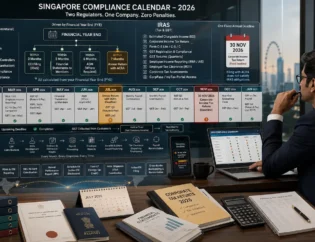
Singapore follows a clear and well defined tax calendar for corporate entities as prescribed by the Inland Revenue Authority of Singapore.
- Estimated Chargeable Income ECI submission.
Companies must submit ECI within three months from the end of their financial year unless exempted under conditions specified by the Inland Revenue Authority of Singapore. - Corporate Income Tax Return filing.
Form C S or Form C must be filed by the prescribed annual deadline in accordance with guidelines issued by the Inland Revenue Authority of Singapore. - Tax payment deadline.
Payment of assessed corporate tax must be completed within one month from the date of the Notice of Assessment issued by the Inland Revenue Authority of Singapore.
These corporate tax deadlines singapore apply regardless of whether the company has generated profits during the financial year.
Consequences of Missing Corporate Tax Deadlines
Failure to meet statutory deadlines monitored by the Inland Revenue Authority of Singapore may result in the following actions.
- Late filing penalties imposed by IRAS.
- Issuance of estimated tax assessments without considering actual expenses.
- Additional enforcement measures such as summons or director level liability in severe cases.
Tracking deadlines proactively helps businesses maintain compliance and avoid unnecessary financial exposure.
Corporate Tax Compliance Checklist for Singapore Companies
A structured checklist approach helps businesses manage compliance efficiently and reduces the risk of errors during filing.
Pre Filing Compliance Checklist
Before initiating the tax filing process, businesses should ensure the following.
- Books of accounts are complete and reconciled.
- Revenue and expense records are accurately classified.
- Supporting documents such as invoices and contracts are properly maintained.
- Prior year assessments and carry forward items are reviewed.
Filing Stage Compliance Checklist
During the filing phase, companies should verify that.
- The correct tax form Form C or Form C S is selected.
- Tax computations reflect allowable deductions and exemptions accurately.
- Declarations are reviewed before submission.
- Filing is completed within the statutory timeline.
Post Filing Compliance Checklist
After filing, businesses must not overlook post submission responsibilities.
- Review the Notice of Assessment issued by IRAS.
- Confirm accuracy of the assessed tax amount.
- Ensure timely payment of corporate tax.
- Retain records for the minimum statutory retention period.
Following a corporate tax compliance checklist supports accuracy, reduces audit risk, and ensures long term compliance stability.
Common Corporate Tax Compliance Mistakes Businesses Make
Despite a clear regulatory framework, many businesses face compliance issues due to operational gaps or lack of structured processes.
Operational and Accounting Errors
Common errors observed at the operational level include.
- Incorrect revenue recognition timing.
- Omission of deductible business expenses.
- Poor documentation supporting tax claims.
- Inconsistent accounting practices across financial periods.
Filing and Process Related Mistakes
Compliance issues often arise due to procedural lapses such as.
- Late submission of ECI.
- Filing the wrong corporate tax form.
- Ignoring notices or clarification requests from IRAS.
- Relying on estimated figures without proper reconciliation.
Risks for Foreign Owned and Cross Border Businesses
Foreign owned companies and cross border structures face additional risks.
- Misinterpretation of permanent establishment rules.
- Transfer pricing documentation gaps.
- Overlooking withholding tax obligations on cross border payments.
Addressing these issues early helps businesses reduce exposure and maintain regulatory credibility in Singapore.
How Proper Corporate Tax Compliance Supports Business Growth
Corporate tax compliance is often viewed only as a regulatory obligation, but when managed correctly, it plays a direct role in supporting sustainable business growth.
Consistent compliance improves financial clarity by ensuring that income, expenses, and tax positions are accurately recorded and reviewed on a regular basis. This leads to better internal decision making and clearer visibility into business performance.
From a regulatory perspective, compliant businesses face lower audit risk and fewer disruptions caused by notices, clarifications, or enforcement actions. This stability allows management teams to focus on expansion, operations, and strategic planning rather than corrective compliance work.
For companies seeking external funding, partnerships, or regional expansion, a clean tax compliance record strengthens credibility with investors, banks, and counterparties. It signals operational discipline and reduces due diligence friction during growth initiatives.
When Businesses Should Seek Professional Corporate Tax Support
While basic compliance may be manageable for smaller and less complex entities, certain situations increase compliance risk and warrant professional corporate tax support.
Businesses should consider external support when operating under the following conditions.
- Multiple revenue streams or complex expense structures.
- Foreign shareholders, directors, or group entities.
- Cross border transactions or overseas income exposure.
- Frequent regulatory changes impacting tax treatment.
- Prior compliance gaps or ongoing notices from IRAS.
Professional support helps businesses interpret regulations correctly, maintain compliance consistency, and manage tax obligations efficiently without operational disruption.
For companies operating in or expanding into Singapore, structured corporate tax support in Singapore becomes especially relevant as regulatory expectations increase with scale and cross border exposure.
Key Takeaways for Singapore Businesses
Corporate tax compliance in Singapore is a continuous process that extends beyond annual filing requirements.
Businesses must focus on maintaining accurate records, following prescribed filing processes, and meeting statutory deadlines consistently. A structured approach to compliance reduces risk, improves financial discipline, and supports long term operational stability.
Early preparation, process driven execution, and timely reviews help businesses avoid penalties and maintain a strong regulatory standing in Singapore’s well regulated tax environment.
FAQ Section
What is the corporate tax rate in Singapore
Singapore applies a flat corporate income tax rate of 17 percent on chargeable income. Partial tax exemptions and incentive schemes may reduce the effective tax burden for qualifying companies.
Is corporate tax filing mandatory for loss making companies in Singapore
Yes. Companies must file corporate income tax returns even if they have incurred losses or have no taxable income for the financial year.
Who needs to file Estimated Chargeable Income ECI in Singapore
Most companies are required to file ECI within three months from their financial year end unless they qualify for an exemption based on revenue and profit conditions set by IRAS.
What happens if corporate tax is not filed on time in Singapore
Late filing may result in penalties, estimated tax assessments, enforcement actions, and in severe cases, summons issued to company directors.