Written by the AccounTX Editorial Team
Singapore is consistently ranked among the world’s most efficient places to run a business. Its incorporation process is one of the fastest globally, its regulatory infrastructure is digital and well-organised, and its corporate tax framework is one of the most competitive in Asia. But efficiency comes with structure – and that structure includes a set of mandatory annual compliance obligations that every Singapore company must meet, every year, regardless of revenue, trading status, or how many people are in the company.
For Indian entrepreneurs who have incorporated a Singapore Pte Ltd, the compliance calendar adds a second layer of obligation on top of their India-side FEMA and income tax duties. Missing a Singapore compliance deadline does not generate a warning letter first – ACRA removed all informal grace periods from January 2026, meaning penalties now apply from the first day after any filing deadline passes.
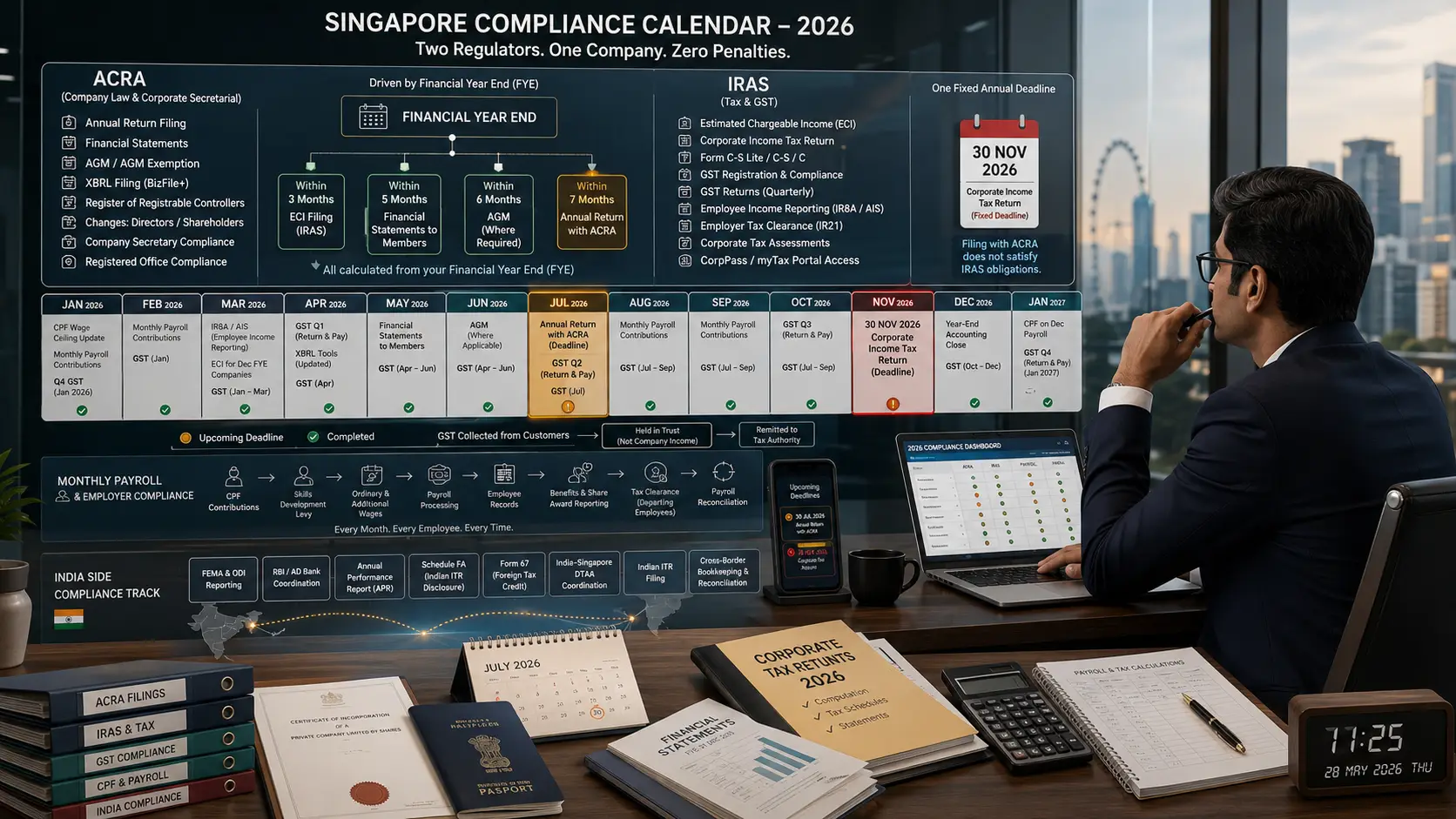
Singapore’s compliance system is managed across two separate regulators – ACRA and IRAS – each with their own filing obligations, deadlines, and penalty regimes. Most ACRA deadlines are relative to the company’s Financial Year End (FYE). The one significant exception is the corporate income tax return (Form C-S/C-S Lite/C), which has a fixed deadline of 30 November every year regardless of when the financial year ends. Understanding this distinction – fixed vs. relative – is the foundation of building an accurate Singapore compliance calendar for your specific company.
This guide covers every key annual compliance deadline for Singapore private limited companies in 2026 – ACRA filings, IRAS tax obligations, GST returns, CPF and payroll obligations, and employer tax reporting – with worked examples, penalty information, and a month-by-month calendar for the most common financial year end (31 December).
If you have not yet incorporated your Singapore company and are considering your options, our complete guide on how to register a company in Singapore from India covers the full formation process before this compliance calendar becomes relevant.
Singapore’s Two Compliance Regulators: ACRA and IRAS
All Singapore company compliance obligations flow from two government bodies. Confusing one with the other – or assuming that filing with one satisfies the other – is one of the most common administrative errors among new company founders.
ACRA – Accounting and Corporate Regulatory Authority
ACRA is Singapore’s company registrar and regulator, responsible for company law obligations under the Companies Act 1967. ACRA manages: company incorporation and de-registration, Annual Return filings via BizFile+, financial statement requirements, AGM rules, changes to company particulars (directors, shareholders, registered address), and the Register of Registrable Controllers (RORC). ACRA’s filing portal is BizFile+.
IRAS – Inland Revenue Authority of Singapore
IRAS is Singapore’s tax authority, responsible for all tax-related obligations including: Estimated Chargeable Income (ECI), corporate income tax returns (Form C/C-S/C-S Lite), GST registration and quarterly returns, employer income reporting (IR8A/AIS), and tax clearance for departing foreign employees (IR21). IRAS’s filing portal is myTax Portal. CorpPass access is required to file on behalf of the company.
⚠ The most important thing to understand: ACRA and IRAS are entirely separate regulatory bodies with separate deadlines, separate filing systems, and separate penalty regimes. Filing your Annual Return with ACRA does not affect your IRAS tax filing obligations. Filing your corporate tax return with IRAS does not satisfy any ACRA requirement. Both must be managed independently and simultaneously.
Your Financial Year End Drives Most of Your Calendar
Before mapping out the compliance year, confirm your company’s Financial Year End (FYE). In Singapore, the FYE is set at the time of incorporation and can be any date the company chooses. The most common FYEs are 31 December (calendar year) and 31 March. The FYE drives the deadlines for ECI, financial statements, AGM, and Annual Return.
The table below shows how the same rules produce different specific deadlines for three common FYE dates:
| Obligation | Rule | 31 Dec 2025 FYE | 31 Mar 2026 FYE | 30 Sep 2025 FYE |
| Financial statements to members | Within 5 months of FYE | 31 May 2026 | 31 August 2026 | 28 February 2026 |
| AGM (if required) | Within 6 months of FYE | 30 June 2026 | 30 September 2026 | 31 March 2026 |
| ECI filing with IRAS | Within 3 months of FYE | 31 March 2026 | 30 June 2026 | 31 December 2025 |
| Annual Return with ACRA | Within 7 months of FYE | 31 July 2026 | 31 October 2026 | 30 April 2026 |
| Corporate Tax Return (Form C-S/C) | Fixed: 30 November YA | 30 November 2026 | 30 November 2026 | 30 November 2026 |
The key takeaway: four of the five major annual obligations shift with your FYE. Only the corporate income tax return has a fixed deadline – 30 November – regardless of when the financial year ends. This is a unique characteristic of Singapore’s tax system that surprises many new founders.
Month-by-Month Singapore Compliance Calendar – 2026
The following calendar is structured for a company with a 31 December Financial Year End – the most common FYE in Singapore. Where obligations apply to all companies regardless of FYE (CPF monthly, GST quarterly, and the 30 November tax return), they are clearly marked. All other dates shown are for the December FYE example, with the underlying rule stated so you can calculate your own dates.
January 2026
| Date | Obligation | Who It Applies To | Notes |
| 1 January 2026 | New CPF Ordinary Wage ceiling takes effect: S$8,000/month | All Singapore employers of SC and PR staff | CPF contributions are now computed on the first S$8,000 of monthly salary – increased from S$6,800. Update payroll software before January payroll run. |
| 14 January 2026 | CPF contributions + SDL for December 2025 payroll | All Singapore employers of SC/PR staff | Hard deadline – no extensions. If 14th falls on weekend/public holiday, deadline moves to next working day. Late payment: 1.5% per month interest, min S$5. |
| 31 January 2026 | GST F5 return + payment for October–December 2025 quarter | GST-registered companies on standard calendar quarters | Q4 2025 GST return. Due 1 month after quarter end. File and pay via IRAS myTax Portal. Late penalty: 5% on outstanding tax + 2% per month. |
February – March 2026
| Date | Obligation | Who It Applies To | Notes |
| 14 February 2026 | CPF contributions + SDL for January 2026 payroll | All Singapore employers of SC/PR staff | Standard monthly CPF/SDL payment. |
| 1 March 2026 | IR8A / AIS annual employee income submission to IRAS | All Singapore employers – mandatory AIS for 5+ employees; Form IR8A for smaller employers | Report all 2025 employee income to IRAS – salary, bonus, director’s fees, commissions, allowances, and benefits. AIS submission is mandatory for employers with 5+ employees and must be submitted electronically. File Appendix 8A for employees who received non-cash benefits; Appendix 8B for employees with stock option or share award gains. Non-compliance attracts penalties under the Income Tax Act. |
| 31 March 2026 | ECI filing for 31 December 2025 FYE companies | All companies with 31 December 2025 FYE (unless ECI waiver applies) | File Estimated Chargeable Income via IRAS myTax Portal within 3 months of FYE. ECI waiver applies ONLY if BOTH conditions are met: annual revenue ≤ S$5M AND ECI is nil. Profitable companies under S$5M revenue must still file. Late ECI: penalty up to S$1,000 + IRAS may issue estimated assessment. |
April 2026
| Date | Obligation | Who It Applies To | Notes |
| 14 April 2026 | CPF contributions + SDL for March 2026 payroll | All Singapore employers of SC/PR staff | Standard monthly payment. |
| 15 April 2026 | XBRL tool update deadline – updated ACRA BizFinx and MUT tools mandatory | All companies that file financial statements in XBRL format with ACRA | ACRA updated its Multi-Upload Tool (MUT) and BizFinx Preparation Tool (PrepTool). The updated versions must be adopted from 15 April 2026. Companies using older software versions for XBRL preparation must upgrade before their next Annual Return filing. |
| 30 April 2026 | GST F5 return + payment for January–March 2026 quarter | GST-registered companies on standard calendar quarters | Q1 2026 GST return. 1 month after quarter end. File via myTax Portal. Both filing and payment due on the same date. Ensure GST collected has been set aside throughout the quarter – GST revenue is a tax liability, not company income. |
May – June 2026
| Date | Obligation | Who It Applies To | Notes |
| 31 May 2026 | Financial statements to all members – 31 Dec FYE companies (AGM-exempt) | Private companies with 31 December 2025 FYE that have dispensed with AGM | Rule: within 5 months of FYE. Sending financial statements to all members within this window is the condition that allows the company to dispense with a formal AGM. If not sent within 5 months and any member requests an AGM, one must be held. |
| 30 June 2026 | AGM deadline for 31 December FYE companies (if AGM not dispensed with) | Private companies with 31 December 2025 FYE where an AGM is required | Rule: within 6 months of FYE. Most private Pte Ltds with few shareholders will have dispensed with the AGM. If a member has requested an AGM, it must be held by this date. Failure to hold a required AGM: up to S$5,000 penalty per officer per breach. |
Need end-to-end Singapore compliance management from India?
AccounTX handles all ACRA and IRAS filing obligations for Indian-owned Singapore companies – Annual Return, ECI, Form C-S, GST, CPF, and IR8A – so no deadline is ever missed. Book a free consultation with our team today.
July 2026 – The Critical ACRA and GST Month
| Date | Obligation | Who It Applies To | Notes |
| 31 July 2026 | Annual Return (AR) filing with ACRA – 31 December FYE companies | All private limited companies with 31 December 2025 FYE | Rule: within 7 months of FYE. File via BizFile+. ACRA filing fee: S$60. Most companies must attach financial statements in XBRL format. Exempt Private Companies (EPCs) with revenue under S$5M may qualify for simplified filing. From January 2026: NO grace period – S$300 penalty applies from 1 August 2026 if not filed. S$600 if still not filed by 31 October 2026 (3+ months late). Three consecutive late ARs can lead to director disqualification. |
| 31 July 2026 | GST F5 return + payment for April–June 2026 quarter | GST-registered companies on standard calendar quarters | Q2 2026 GST return. File and pay via IRAS myTax Portal. Note that this date coincides with the Annual Return deadline for December FYE companies – one of the busiest compliance days in the Singapore corporate calendar. |
August – October 2026
| Date | Obligation | Who It Applies To | Notes |
| 14 August 2026 | CPF + SDL for July 2026 payroll | All Singapore employers of SC/PR staff | Standard monthly payment. |
| 31 October 2026 | GST F5 return + payment for July–September 2026 quarter | GST-registered companies on standard calendar quarters | Q3 2026 GST return. 1 month after quarter end. File and pay via myTax Portal. |
| 31 October 2026 | YA 2025 corporate tax notices – IRAS assessment | Companies that filed ECI for YA 2025 | IRAS typically issues Notices of Assessment for YA 2025 around this period. Review and raise objection within 30 days if the assessment is incorrect. |
November 2026 – The Corporate Tax Month
| Date | Obligation | Who It Applies To | Notes |
| 30 November 2026 | Corporate Income Tax Return (Form C-S / C-S Lite / Form C) – YA 2026 | ALL Singapore-incorporated companies – regardless of FYE, revenue, or trading status | The single fixed deadline in Singapore’s corporate compliance calendar. File via IRAS myTax Portal (CorpPass login required). Choose the correct form: Form C-S Lite (revenue ≤ S$200,000), Form C-S (revenue ≤ S$5 million, simplified), or Form C (revenue above S$5 million, full return). Filing is mandatory for all companies – including dormant ones – unless IRAS has granted a specific dormancy waiver. The YA 2026 40% CIT Rebate (capped at S$30,000) is automatically applied by IRAS – no claim required. |
December 2026 – Year-End
| Date | Obligation | Who It Applies To | Notes |
| Throughout December | Year-end book close for December FYE companies | All companies with 31 December FYE | Record all December transactions, reconcile bank accounts, accounts receivable, accounts payable, and accruals. Finalise year-end payroll including any December bonuses – important for CPF computation on both Ordinary Wages and Additional Wages. |
| 14 December 2026 | CPF + SDL for November 2026 payroll | All Singapore employers of SC/PR staff | Standard monthly payment. Note: December bonus payments made in December will create Additional Wages (AW) CPF obligations – ensure these are correctly calculated before the final December payroll cut-off. |
| 31 December 2026 | Financial Year End for December FYE companies | All companies with 31 December FYE | The FYE triggers the countdown to all relative deadlines for the next cycle: ECI by 31 March 2027, financial statements to members by 31 May 2027, AGM (if required) by 30 June 2027, Annual Return by 31 July 2027. |
January 2027 (from 2026 obligations)
| Date | Obligation | Notes |
| 14 January 2027 | CPF + SDL for December 2026 payroll (including year-end bonuses) | December bonuses are Additional Wages. Total AW subject to CPF is capped at S$102,000 minus the total Ordinary Wages already subject to CPF during the year. Review the AW cap computation carefully – December is when errors typically accumulate. |
| 31 January 2027 | GST F5 return + payment for October–December 2026 quarter | Q4 2026 GST return. 1 month after quarter end. |
The Six Core Annual Obligations: What Every Singapore Founder Must Understand
1. Estimated Chargeable Income (ECI) – The Early Tax Estimate
ECI is Singapore’s early tax estimate system – an obligation to file a preliminary estimate of taxable profit with IRAS within 3 months of your FYE, before accounts are fully finalised. It gives IRAS early visibility into a company’s approximate tax position for the year.
The ECI waiver is one of the most misunderstood aspects of Singapore tax compliance. The waiver applies only when BOTH conditions are simultaneously met: annual revenue is S$5 million or less, AND the ECI is nil (the company made no taxable profit). A company with S$3M in revenue and a S$50,000 taxable profit does not qualify for the waiver – it must file ECI within 3 months of FYE. The common misconception that “small companies don’t need to file ECI” has led many founders into penalties. When in doubt, file.
One practical benefit of early ECI filing: IRAS offers a GIRO instalment plan for companies that file ECI early (before the end of the first or second month after FYE). Instead of paying the estimated tax as a lump sum, the company can spread the payment over 10 monthly GIRO instalments – a meaningful cash flow benefit for growing companies.
2. Annual Return – The ACRA Filing
The Annual Return is filed with ACRA via BizFile+ within 7 months of FYE. It confirms the company’s registered particulars – directors, shareholders, company secretary, registered address, share capital – and attaches financial statements in the required format.
XBRL requirement: Most Singapore-incorporated companies must file their financial statements in XBRL (eXtensible Business Reporting Language) format rather than as a simple PDF. Small Exempt Private Companies (EPCs) with annual revenue below S$5 million may qualify for simplified XBRL filing or PDF-only filing. Confirm your filing category with your company secretary before preparing accounts – the wrong format results in a rejected filing.
The January 2026 penalty change: ACRA removed all informal grace periods effective January 2026. Previously, there was an understanding that ACRA would not immediately issue a penalty if a company filed a few days late. That is no longer the case. The S$300 penalty (within 3 months late) or S$600 penalty (more than 3 months late) now applies from the first day after the deadline. Set reminders well in advance.
3. Corporate Income Tax Return – Form C-S / C-S Lite / Form C
The corporate income tax return – the full annual declaration of taxable income, deductions, and tax payable – is due on 30 November of the Year of Assessment. YA 2026 covers the financial year ending in 2025 (e.g., FY January–December 2025 = YA 2026, return due 30 November 2026).
The three form types and their thresholds:
- Form C-S Lite: For companies with annual revenue of S$200,000 or less. The most streamlined form – designed for micro-businesses and early-stage startups.
- Form C-S: For companies with annual revenue of S$5 million or less that meet certain other conditions (no complex arrangements, no claims for group relief, etc.). A simplified form with fewer disclosure requirements than Form C.
- Form C: For companies with annual revenue above S$5 million, or companies below the threshold but with complex tax positions. The full return, requiring detailed supporting schedules.
All forms are filed via the IRAS myTax Portal – paper filing is not accepted. The company’s CorpPass administrator must have the relevant authorisation level to access corporate tax filing functions.
4. GST Quarterly Returns – For Registered Companies
GST registration is mandatory once a company’s taxable turnover exceeds S$1 million in any rolling 12-month period. GST is charged at 9% and must be collected from customers and remitted to IRAS quarterly. The key principle: GST collected from your customers is not the company’s revenue – it is a liability to IRAS that must be tracked separately throughout the quarter and remitted within 1 month of the quarter end.
GST 2026 Quarterly Deadlines
| GST Quarter | Period | Filing and Payment Deadline |
| Q1 2026 | January – March 2026 | 30 April 2026 |
| Q2 2026 | April – June 2026 | 31 July 2026 |
| Q3 2026 | July – September 2026 | 31 October 2026 |
| Q4 2026 | October – December 2026 | 31 January 2027 |
Note that GST quarter periods are not always aligned to calendar quarters depending on when the company registered for GST. Confirm your assigned quarter periods with your GST registration documentation or IRAS correspondence.
5. CPF, SDL, and Monthly Payroll Obligations
Singapore’s payroll compliance is notably different from most other jurisdictions in one important respect: there is no monthly income tax withholding from employee salaries. Singapore employees handle their own personal income tax through annual self-assessment. What employers do manage monthly is CPF and SDL.
CPF – Central Provident Fund
CPF is Singapore’s mandatory pension and social security scheme. It applies only to Singapore Citizens and Permanent Residents – not to foreign work pass holders (Employment Pass, S Pass, or Work Permit holders). Both the employer and employee contribute to CPF monthly:
| Employee Age | Employee Contribution Rate | Employer Contribution Rate | Total |
| 55 years and below | 20% | 17% | 37% |
| Above 55 to 60 | 18% | 16% | 34% |
| Above 60 to 65 | 12.5% | 12.5% | 25% |
| Above 65 to 70 | 7.5% | 9% | 16.5% |
| Above 70 | 5% | 7.5% | 12.5% |
From January 2026, the CPF Ordinary Wage ceiling is S$8,000 per month (increased from S$6,800). CPF is computed on the first S$8,000 of monthly salary. Wages above S$8,000 are not subject to CPF contributions. The employer deducts the employee’s share from salary and pays both the employer and employee contributions to the CPF Board by the 14th of the following month.
Skills Development Levy (SDL)
SDL is an employer-only contribution paid on the wages of all employees – including foreign work pass holders (unlike CPF, which excludes foreigners). SDL funds government training and skills development programmes. The rate is 0.25% of total monthly remuneration per employee, with a minimum of S$2 per employee per month and a maximum of S$11.25 per employee per month. SDL is submitted and paid together with CPF contributions on the 14th of each month.
6. IR8A and Annual Employer Reporting to IRAS
Unlike payroll systems in the UK and Australia, Singapore employers do not deduct income tax from employee salaries each month. Instead, all employers report their employees’ annual earnings to IRAS once a year, by 1 March, so IRAS can issue individual tax assessments. This annual reporting obligation is either:
- Auto-Inclusion Scheme (AIS): Mandatory for employers with 5 or more employees. Income data is submitted electronically to IRAS by 1 March, and IRAS automatically pre-fills the employee’s personal income tax return. Covers salary, bonus, director’s fees, commissions, allowances, and benefits-in-kind.
- Form IR8A: For employers with fewer than 5 employees. The employer prepares an IR8A for each employee and provides it directly to the employee by 1 March, so the employee can use it when filing their personal income tax return.
Additional supplementary forms:
- Appendix 8A: For any employee who received non-cash benefits (accommodation, company car, club memberships, etc.)
- Appendix 8B: For any employee who received gains from employee stock options, share awards, or share purchase plans
Budget 2026: The 40% CIT Rebate – What Every Singapore Company Should Know
Singapore’s Budget 2026 announced a significant one-year tax relief measure specifically for Year of Assessment 2026:
- 40% Corporate Income Tax (CIT) Rebate on tax payable for YA 2026, capped at S$30,000 per company
- S$2,000 CIT Rebate Cash Grant for qualifying active companies – those that employed at least one local employee (SC or PR on CPF) during the 2025 calendar year
Both benefits are applied automatically by IRAS – no separate application, claim form, or election is required. The CIT Rebate is applied to the computed tax payable when IRAS processes the YA 2026 corporate tax return. The S$2,000 cash grant is disbursed separately to qualifying companies.
For a new Singapore company in its first three years of operation, the CIT Rebate stacks with the Start-Up Tax Exemption (SUTE) – the 75% exemption on the first S$100,000 of chargeable income and 50% on the next S$100,000. The combined effect in the first three years can bring the effective corporate tax rate well below Singapore’s already competitive 17% headline rate.
⚠ Budget 2026 has not confirmed this rebate for YA 2027. Companies should not assume it will be renewed when making multi-year tax projections.
IR21: Tax Clearance for Departing Foreign Employees – Don’t Miss This
When a non-Singaporean employee (any work pass holder) leaves the company – whether due to resignation, contract end, or repatriation – the employer has a mandatory tax clearance obligation with IRAS before the employee’s final monies are released.
The IR21 process:
- File Form IR21 with IRAS at least one month before the employee’s last day (or as soon as the employer is notified of the departure)
- Withhold all monies due to the employee – salary, notice pay, leave encashment, bonus – until IRAS clearance is received
- IRAS reviews the employee’s tax position and issues a tax clearance directive
- Pay the employee their cleared monies after receiving IRAS confirmation
- Cancel the employee’s work pass with MOM (Ministry of Manpower) within 7 days of the last working day
Failing to withhold monies pending IR21 clearance – or paying the employee before IRAS clearance is received – makes the employer personally liable for any taxes that IRAS later finds are owed by the departing employee. This is one of the most commonly overlooked compliance traps for Singapore companies with foreign employees.
RORC and Ongoing Secretarial Changes: Obligations That Run Throughout the Year
Register of Registrable Controllers (RORC)
Every Singapore company must maintain a RORC – a register identifying all individuals who ultimately own or control the company (those with 25% or more of shares, voting rights, or significant influence over management). Any change to the RORC must be filed with ACRA within 2 business days of the change occurring. The RORC is not publicly visible in the BizFile+ register, but ACRA can request it at any time. Non-maintenance is an offence under the Companies Act.
Changes to Company Particulars
Changes to any of the following must be filed with ACRA promptly via BizFile+:
- Changes to directors (appointment, resignation, change of particulars)
- Changes to shareholders (share transfers, new share issuances, change of registered address)
- Company name change
- Change of registered office address
- Changes to authorised share capital or paid-up capital
- Changes to company secretary
Most of these changes must be filed within 14 days of the change. All changes are public and visible in the BizFile+ register immediately upon filing.
Singapore Company Compliance Penalties: Quick Reference
| Filing / Obligation | Penalty for Non-Compliance |
| ACRA Annual Return – within 3 months late | S$300 composition fine (from day 1 after deadline – no grace period) |
| ACRA Annual Return – more than 3 months late | S$600 composition fine |
| ACRA Annual Return – persistent non-filing | ACRA striking off proceedings; director disqualification (3 consecutive late ARs) |
| Failure to hold AGM (when required) | Up to S$5,000 per officer per breach |
| ECI – late or non-filing | Up to S$1,000 penalty + IRAS estimated assessment |
| Form C-S / C / C-S Lite – late filing | Compound penalties and surcharges; IRAS estimated assessment may be issued |
| GST – late filing | 5% late payment penalty on outstanding tax |
| GST – continued non-payment | Additional 2% per month on outstanding balance |
| CPF – late contribution | 1.5% per month interest, minimum S$5; may be compounded |
| CPF – non-payment (serious cases) | Prosecution under CPF Act; fines and/or imprisonment for directors |
| IR8A / AIS – failure to submit | Penalties under Income Tax Act; IRAS audit exposure |
| IR21 – failure to file before foreign employee leaves | Employer personally liable for employee’s unpaid taxes |
| RORC – not maintained or not updated within 2 days | Offence under Companies Act; fines applicable |
India-Side Obligations for Indian Founders with Singapore Companies
Indian entrepreneurs who own Singapore companies carry parallel compliance obligations in India under FEMA, the RBI, and the Income Tax Department. Both compliance calendars must be managed simultaneously.
| India-Side Obligation | Deadline | Notes |
| Annual Performance Report (APR) via Authorised Dealer bank | Within 6 months of Singapore company’s FYE | For December FYE: APR due by 30 June 2027 for FY2026. Late filing: Rs. 7,500 + 0.025% of investment amount per year of delay. |
| Schedule FA disclosure in Indian ITR | By Indian ITR due date (July 31 or October 31) | Singapore company shares are foreign assets. Non-disclosure: Rs. 10 lakh penalty per asset per year under the Black Money Act. File ITR-2 or ITR-3 – not ITR-1. |
| Form 67 – claim India-Singapore DTAA relief | Before Indian ITR due date | Claim relief on Singapore-withheld taxes (if any) under the India-Singapore DTAA. Must be filed before the ITR due date – cannot be filed after. |
| Indian ITR filing | July 31 (non-audited) / October 31 (audited) | Singapore dividends and other income from the Singapore entity must be declared in India. Subject to India-Singapore DTAA and applicable Indian tax rates. |
Frequently Asked Questions: Singapore Company Annual Compliance Deadlines
When must a Singapore Pte Ltd file its Annual Return with ACRA?
Within 7 months of the Financial Year End (FYE). For a company with a 31 December 2025 FYE, the Annual Return is due by 31 July 2026. The ACRA filing fee is S$60. From January 2026, ACRA removed all grace periods – the S$300 late penalty applies from the first day after the due date, rising to S$600 if more than 3 months late. Three consecutive late Annual Returns can lead to director disqualification.
What is the ECI filing deadline for Singapore companies?
ECI must be filed within 3 months of the Financial Year End. For a 31 December 2025 FYE, ECI is due by 31 March 2026. The ECI filing waiver applies only if BOTH conditions are met: annual revenue ≤ S$5M AND ECI is nil. Profitable companies below S$5M revenue must still file. Late ECI: up to S$1,000 penalty + IRAS may issue an estimated assessment.
When is the Singapore corporate income tax return deadline for 2026?
30 November 2026 – fixed for all Singapore companies regardless of FYE. This is the one deadline in Singapore’s compliance calendar that does not move with the financial year end. File Form C-S Lite (revenue ≤ S$200K), Form C-S (revenue ≤ S$5M), or Form C (above S$5M) via IRAS myTax Portal. Filing is mandatory even for dormant companies unless IRAS has granted a specific waiver.
Do Singapore private companies have to hold an AGM?
Most private Pte Ltd companies are exempt from holding an AGM, provided financial statements are sent to all members within 5 months of FYE. If any member requests an AGM in writing, one must be held within 6 months of FYE. The Annual Return with ACRA must still be filed within 7 months of FYE regardless of AGM status.
What are the GST filing deadlines for Singapore companies in 2026?
Quarterly GST F5 returns are due 1 month after each quarter end. Standard 2026 deadlines: 30 April (Q1), 31 July (Q2), 31 October (Q3), 31 January 2027 (Q4). GST registration is mandatory once annual taxable turnover exceeds S$1 million. Current GST rate: 9%. Late filing/payment: 5% penalty + 2% per month.
When are CPF contributions due for Singapore employers?
CPF (for SC and PR employees) plus SDL (for all employees including foreigners) must be paid by the 14th of the following month. From January 2026, the CPF Ordinary Wage ceiling is S$8,000 per month. Combined CPF rates for employees aged 55 and below: 37% (20% employee + 17% employer). Late CPF: 1.5% per month interest, minimum S$5.
What is the IR8A deadline and is it mandatory for all Singapore employers?
IR8A (or AIS) employee income submission to IRAS is due by 1 March each year, covering the preceding calendar year’s income. Mandatory AIS electronic submission for employers with 5 or more employees. Smaller employers issue Form IR8A directly to employees. File Appendix 8A for non-cash benefits; Appendix 8B for stock option or share award gains.
What is the Budget 2026 CIT Rebate for Singapore companies?
Budget 2026 provides a 40% CIT Rebate for YA 2026, capped at S$30,000 per company. Qualifying active companies with at least one local CPF-contributing employee during 2025 also receive a S$2,000 CIT Rebate Cash Grant. Both are automatically applied by IRAS – no application needed. The combined maximum benefit is S$32,000. This is a one-year measure for YA 2026 only.
Build Your Calendar Once – Then Run It Every Year
Singapore’s compliance framework is logical, well-documented, and manageable – but it runs on two separate regulatory tracks (ACRA and IRAS) with timelines that mostly shift with your Financial Year End but converge on one fixed date (30 November) that applies universally. Once your FYE is known and your obligations mapped, the same calendar repeats annually with only the specific dates changing.
The most important operational change in 2026 is ACRA’s removal of all grace periods from January 2026. There is now no buffer between the Annual Return due date and the penalty. A company that previously filed a few days late without consequence now incurs an automatic S$300 charge from the first day of lateness. Combined with the IR21 trap for departing foreign employees and the ECI waiver misconception that catches many small companies, these are the three compliance traps that generate most unexpected penalties for Singapore companies owned by Indian entrepreneurs.
AccounTX’s Singapore Global Desk provides complete annual compliance management for Indian-owned Singapore Pte Ltd companies – ECI and Form C-S preparation, ACRA Annual Return filing, quarterly GST returns, monthly CPF and SDL computation and filing, IR8A/AIS annual employer submissions, RORC maintenance, and India-side FEMA/ODI APR filing. We manage both regulators, both jurisdictions, from a single engagement.
Contact AccounTX today. Tell us your Singapore company’s FYE, structure, employee headcount, and current compliance status and we will map out your complete 2026/27 compliance calendar with every specific deadline and action required.
About the Author
Satish Sarawagi is a Partner at AccounTX with over a decade of experience advising Indian entrepreneurs on cross-border company formation, international taxation, and multi-jurisdiction compliance across the USA, Singapore, Australia, the UK, and the UAE. He leads AccounTX’s Global Desk practice and has guided 100+ Indian founders through the Singapore Pte Ltd formation and compliance process. Connect on LinkedIn.