Why 2026 Changes Matter and What This Article Delivers
From late 2025, the GST ecosystem moved from permissive warnings to system-level hard validations that can block GSTR-3B submission when reclaimed ITC or RCM entries exceed ledger balances. This shift has fundamentally changed how monthly compliance must be handled. Filing is no longer just a reporting exercise. It is now directly dependent on real-time ledger integrity inside the GST portal.
These changes are part of broader 2026 GST compliance reforms explained in our detailed analysis of 2026 GST portal update changes.
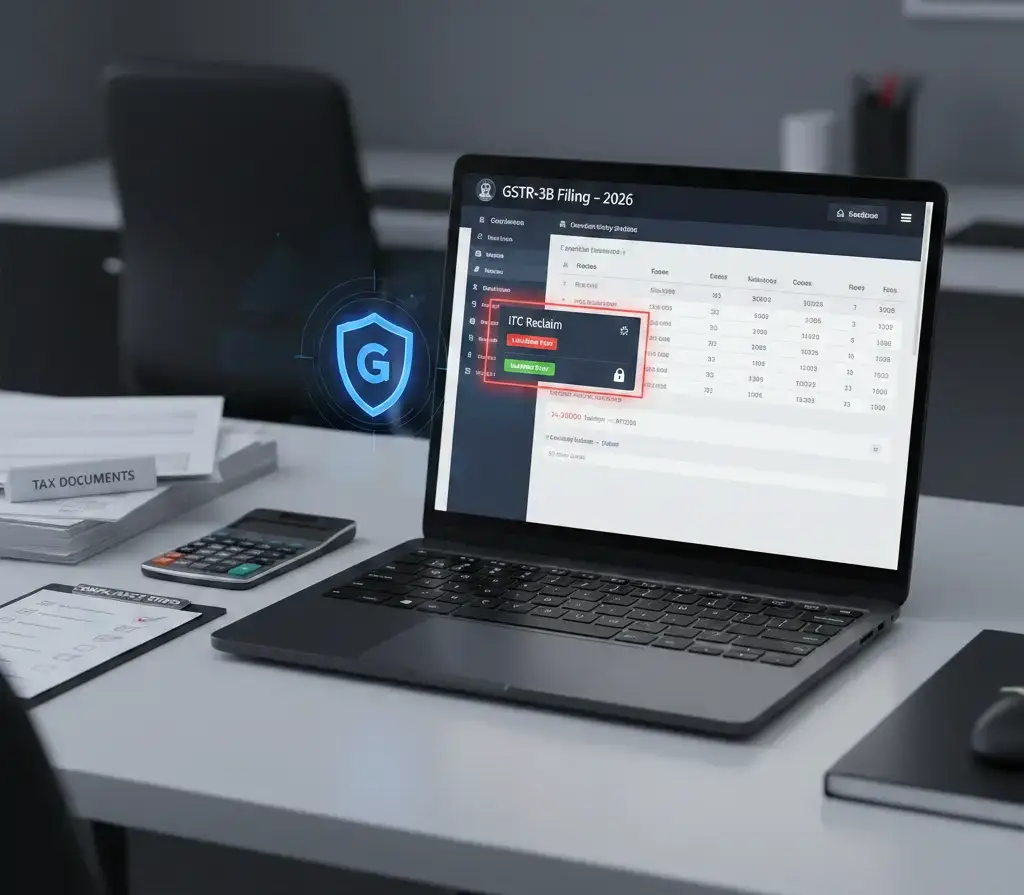
Under the new system behavior, if reclaimed ITC in Table 4D(1) exceeds the balance available in the Electronic Credit Reversal and Reclaimed Statement ledger, or if RCM credit exceeds its corresponding ledger balance, the return cannot be filed. The portal blocks submission until the discrepancy is corrected.
This article explains what changed, how the ITC reclaim mechanism now operates in 2026, and how to structure reconciliations to avoid filing disruptions. It also lays out a clear, practical approach that finance teams can adopt immediately.
1. What Changed: The Shift to Hard Validations and Why It Matters
In December 2025, GSTN introduced hard validation checks that convert earlier advisory-style warnings into system blocks. These validations prevent GSTR-3B filing in the following situations:
- Reclaimed ITC exceeds the available balance in the ITC Reclaim Ledger
• RCM ITC claimed exceeds the balance in the RCM ledger
• The Electronic Credit Reversal and Reclaimed Statement reflects a negative balance
• Mismatch conditions create excess reclaim situations
Previously, such mismatches would generate alerts but filing could proceed. In 2026, that flexibility no longer exists.
This change significantly increases compliance pressure at month end. Finance teams must now complete reconciliation before attempting to file, not after. The system enforces ledger discipline, meaning every reclaim must be backed by portal-recorded reversal history.
The impact is both operational and financial:
Operational impact
• Filing delays if reconciliations are incomplete
• Increased coordination required between purchase, tax, and accounting teams
Financial impact
• Temporary cash outflow if ITC cannot be reclaimed due to ledger limitations
• Exposure to interest in case of delayed filing
Businesses facing recurring reconciliation challenges often consider structured GST-compliant bookkeeping support to maintain monthly ledger discipline and avoid validation failures.
The compliance environment has therefore shifted from reactive correction to preventive validation.
2. Understanding the Ledgers and the ECRS Framework
To manage ITC reclaim correctly in 2026, it is essential to understand how the Electronic Credit Reversal and Reclaimed Statement functions within the GST system.
The ECRS records:
- Temporary ITC reversals reported in Table 4(B)(2) of GSTR-3B
• Subsequent reclaims reported in Table 4(A)(5) and Table 4(D)(1)
Every reversal increases the reclaimable balance in the ECRS ledger. Every reclaim reduces it. The ledger must never go negative.
Separately, the RCM ledger tracks ITC arising from reverse charge transactions. Claims made under RCM must not exceed the balance supported by tax paid under reverse charge.
The new validation logic links:
Supplier invoice data
GSTR-2B auto-population
Reversal entries
Reclaim entries
Ledger balances
If any of these are misaligned, the portal blocks filing.
Therefore, teams need structured reconciliation that connects:
Purchase register → GSTR-2B → ECRS ledger → GSTR-3B reporting
Without this structured matching, reclaim attempts may exceed available ledger support, triggering a hard stop. Businesses that ignore systematic reconciliation risk broader compliance exposure, including potential GST registration suspension due to bank details or data mismatch issues.
3. Step-by-Step ITC Reclaim Process in 2026
To avoid filing disruption, organizations are required to follow a disciplined reclaim sequence.
Step 1: Identify ITC reversal
Confirm why ITC was reversed earlier. Common reasons include supplier non-filing, payment delays beyond 180 days, provisional mismatch, or compliance risk.
Step 2: Confirm eligibility for reclaim
Ensure the condition that triggered reversal is resolved. For example:
• Supplier has filed GSTR-1
• Invoice reflects correctly in GSTR-2B
• Payment conditions are satisfied
Step 3: Verify ECRS balance
Before entering reclaim in Table 4(D)(1), check that the ECRS ledger shows sufficient balance equal to or greater than the reclaim amount.
Step 4: Enter reclaim in correct table
Report reclaim in Table 4(D)(1) strictly up to the ledger balance. Excess reporting will block filing.
Step 5: Validate RCM credits separately
Ensure RCM tax paid matches ITC being claimed. Reconcile RCM liability ledger and electronic credit ledger before filing.
Step 6: Perform final validation review
Download draft GSTR-3B summary. Cross-verify:
• ITC claimed vs GSTR-2B
• Reclaim amount vs ECRS balance
• RCM claim vs RCM ledger
Only after confirming these balances should filing proceed.
This structured approach significantly reduces the risk of system rejection and also supports smoother year-end reporting under the GSTR-9 and 9C reconciliation checklist process.
4. Month-End Reconciliation Checklist to Prevent Filing Blocks
A preventive compliance model is now essential.
Daily or weekly controls
• Track supplier filing status
• Monitor invoices not appearing in GSTR-2B
• Flag temporary reversals separately in accounting system
Pre-closing controls
• Reconcile purchase register with GSTR-2B
• Review reversal history
• Match ECRS ledger balance with internal reversal tracker
• Validate RCM tax payments
Final filing day checklist
• Confirm reclaim amount does not exceed ECRS ledger
• Ensure no negative balances exist
• Validate interest computation
• Re-check draft return totals
Organizations that implement mid-month reconciliation cycles experience significantly fewer filing disruptions compared to those reconciling only at month end. Many growing businesses strengthen this process through outsourced accounting services that provide monthly GST validation oversight.
5. What to Do When GSTR-3B Filing Is Blocked
Despite precautions, filing may still be blocked. In such cases, the following structured response is recommended.
Step 1: Identify exact validation error
Note the portal error message and identify whether it relates to ECRS or RCM ledger.
Step 2: Extract ledger balances
Download ECRS statement and RCM ledger summary.
Step 3: Compare reclaim entries
Match reported reclaim amount with available balance.
Step 4: Correct the discrepancy
If excess reclaim was reported:
• Reduce reclaim amount
• Carry forward balance to next eligible period
If ledger balance is incorrect due to earlier reporting error:
• Review prior month GSTR-3B
• Correct through appropriate adjustment in current return
Step 5: Escalation
If discrepancy appears to be system-driven and not user error, raise grievance on GST portal with supporting documentation.
System blocks cannot be bypassed. They must be resolved through ledger alignment.
11. Strategic Takeaway for Businesses in 2026
The ITC reclaim process is no longer a flexible reporting adjustment. It is a system-controlled compliance workflow.
Organizations must shift from after-the-fact reconciliation to pre-filing validation discipline.
The key pillars of sustainable compliance are:
Accurate reversal reporting
Continuous ledger reconciliation
Strict reclaim tracking
RCM payment alignment
Strong internal controls
Businesses that treat ITC reclaim as a structured financial control rather than a compliance formality will avoid filing disruptions, reduce interest exposure, and strengthen audit readiness. For companies operating cross-border or through India-focused operations, structured accounting and bookkeeping services in India can significantly reduce GST compliance risk and ensure seamless regulatory alignment.