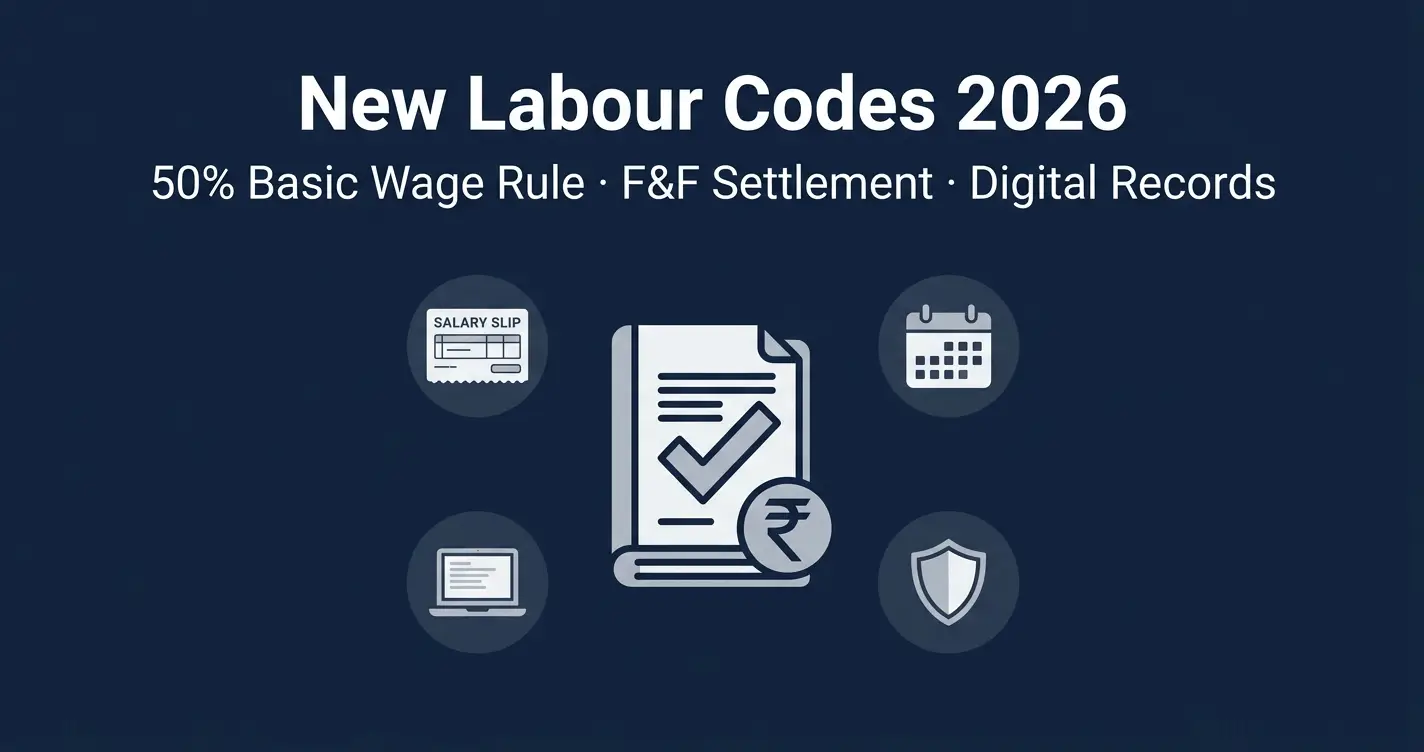
This guide explains what the new Labour Codes mean in practice, how they change your payroll structure, what actions employers must take immediately, and how the Income Tax Act 2025 adds further urgency to the compliance agenda.
The Four New Labour Codes: A Quick Overview
The four codes consolidate 29 separate central labour laws into a unified framework. Here is a summary of each code and its key payroll impact:
| Labour Code | Laws Consolidated | Key Payroll Impact |
| Code on Wages, 2019 | 4 laws incl. Minimum Wages Act, Payment of Wages Act | 50% basic wage rule; salary payment deadlines |
| Code on Social Security, 2020 | 9 laws incl. EPF Act, ESI Act, Gratuity Act | Expanded PF/ESI coverage; gratuity for fixed-term employees after 1 year |
| Industrial Relations Code, 2020 | 3 laws incl. Industrial Disputes Act | F&F settlement within 2 working days |
| OSH Code, 2020 | 13 laws incl. Factories Act | Mandatory digital record-keeping |
The 50% Basic Wage Rule: The Single Biggest Payroll Change
Under the Code on Wages, 2019, the definition of ‘wages’ has been overhauled. Basic pay (including Dearness Allowance) must now constitute at least 50% of an employee’s total CTC. This single rule has the widest payroll impact because it changes:
- PF contribution amounts – PF is calculated on basic wages, so a higher basic means higher PF contributions for both employer and employee.
- Gratuity – calculated on last drawn basic salary, meaning gratuity payouts will increase.
- ESI thresholds – the eligibility threshold (Rs 21,000 gross) may affect more employees if allowances are restructured.
- Income tax – restructuring salary to comply with the 50% basic rule may change the tax efficiency of the CTC package.
What Employers Must Do
- Audit all salary structures immediately – identify employees where basic pay is currently less than 50% of CTC.
- Recalculate PF contributions for all affected employees using the revised basic wage.
- Revise employment contracts and offer letters to reflect the new structure.
- Communicate salary restructuring to employees clearly, explaining that gross take-home may reduce even if CTC remains the same.
- Update payroll software to apply the new wage definition automatically.
Critical: Employers who continue to structure salaries with basic pay below 50% of CTC after November 2025 are in direct violation of the Code on Wages. This can result in penalties and retrospective PF contribution demands.
Full and Final Settlement: The Two-Day Rule
The Industrial Relations Code introduces a strict two-working-day timeline for settling all wages on separation. This applies to:
- Final month’s salary pro-rated to the date of exit.
- Pending leave encashment as applicable.
- Any overtime or incentive payments owed.
Gratuity, reimbursements, and other components must follow as soon as practicable but are not subject to the strict two-day rule.
This demands real-time payroll reconciliation capabilities and tightly integrated HRMS-payroll workflows. Manual F&F processes that used to take weeks are now legally required to be completed in two working days.
Digital Record-Keeping: Now Mandatory
The OSH Code mandates fully digitised records for all employers. You must maintain in digital format:
- Wage registers with employee-wise salary, deductions, and net pay.
- Attendance records – biometric or HRMS-linked digital attendance.
- PF, ESI, PT, and LWF contribution records, month-wise.
- Payslips – issued with mandatory information including wages, tax deductions, and all statutory contributions.
- All statutory registers applicable to your industry and headcount.
Audit Risk: Labour inspectors can now request digital records on short notice. Paper-only records will not satisfy the OSH Code requirement. Cloud-based payroll and HRMS platforms are the most efficient way to comply.
The Income Tax Act 2025: April 1, 2026 Payroll Impact
On top of the Labour Codes, the new Income Tax Act 2025 takes effect April 1, 2026. Here is what changes for payroll:
TDS Recalculation Required
All employers must recalculate TDS for FY 2026-27 under the new Act’s framework. Key changes:
- New IT Rules and Forms are being notified – payroll systems must be updated for compatibility.
- Form 24Q and Form 16 generation must adhere to revised formats.
- Investment declaration forms and the process for collecting declarations from employees may be updated.
Deemed Residency Provision
Indian citizens earning more than Rs 15 lakh in India who are not tax residents of any other country are deemed Indian tax residents. This affects payroll for employees who work part of the year outside India – TDS must account for their total global income.
Two-Day Wage Settlement Aligns with Tax Regime
The two-day F&F rule under the Labour Codes aligns with the Income Tax Act 2025’s requirement for traceable, structured payroll data. All final settlement payments must now be reflected in your TDS working sheets and Form 24Q on a timely basis.
Practical Employer Action Plan for 2026
- Immediate (by April 1, 2026): Restructure all salary packages where basic is less than 50% of CTC. Recalculate PF and gratuity provisions.
- By April 15, 2026: Update payroll software to generate TDS workings and Form 24Q in formats compatible with the Income Tax Act 2025.
- April onwards: Implement digital attendance and wage register systems if not already in place.
- Ongoing: Review F&F processes to ensure compliance with the two-working-day settlement rule.
- Before June 15, 2026: Issue Form 16 to all employees in the revised format under Income Tax Act 2025.
How AccounTX Supports Employer Compliance
The combination of new Labour Codes and the Income Tax Act 2025 means that payroll compliance in India now requires continuous expert oversight, not just periodic filings. AccounTX’s HR and payroll services team provides end-to-end payroll management, salary structure redesign under the new Wage Code, and full statutory compliance across PF, ESI, TDS, PT, and LWF.
For businesses setting up operations in India for the first time, we also handle company incorporation and entity registration and secretarial compliances, ensuring your business is structured for compliance from day one.
Already running payroll? Our team will audit your current salary structures against the 50% basic wage rule, identify compliance gaps, and implement the changes needed – fast. See also our payroll compliance checklist for Indian companies in 2026 for a month-by-month action plan.
Act before April 1, 2026. Salary restructuring and PF recalculation must be in place before the Income Tax Act 2025 takes effect. Contact AccounTX today for a compliance review.
Disclaimer: The information provided in this article is for general informational purposes only and does not constitute legal, tax, financial, or professional advice. While we have made every effort to ensure the accuracy of the content at the time of publication, laws, regulations, and compliance requirements are subject to change. Readers are advised to consult a qualified legal, tax, or compliance professional before making any business decisions based on the information contained herein. AccounTX shall not be held liable for any errors, omissions, or outcomes arising from the use of this information.