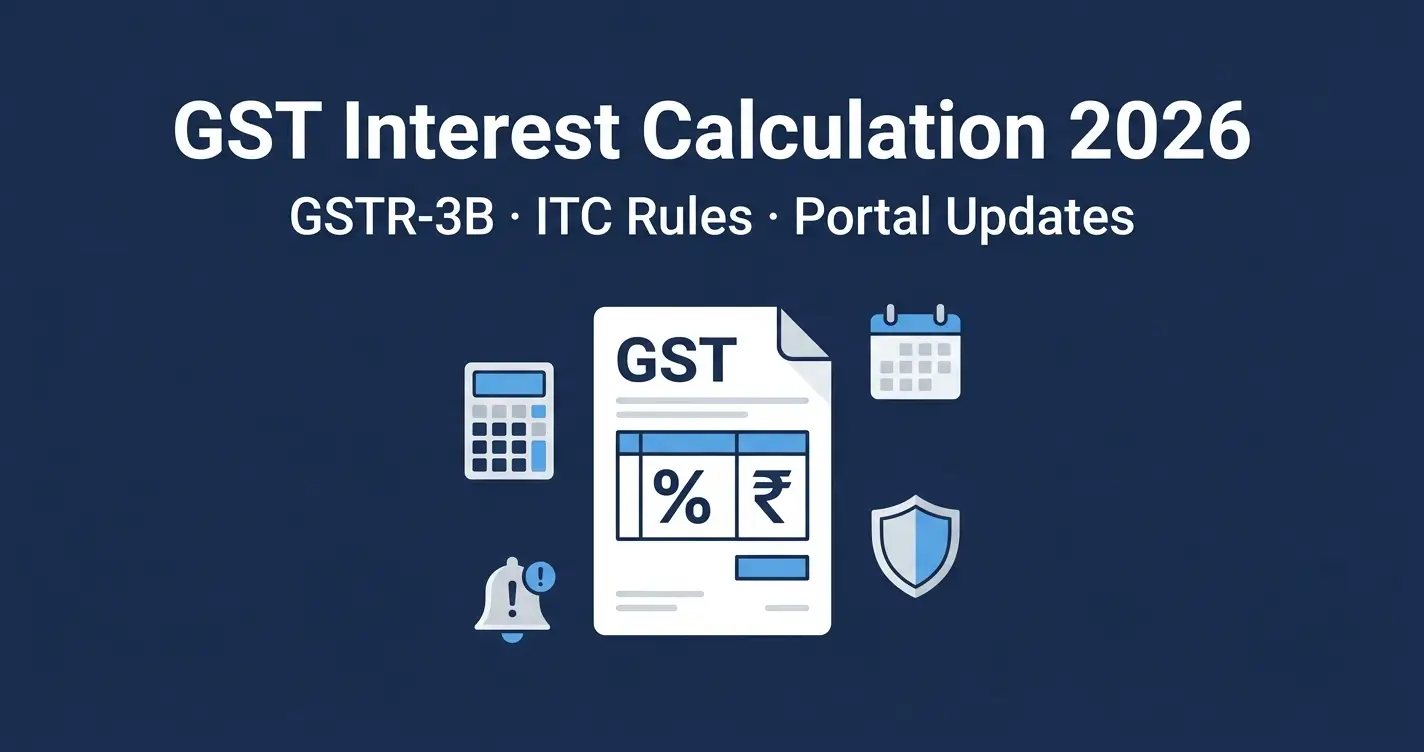
This guide breaks down every major GST change in 2026, how interest is now calculated, what has changed in GSTR-3B from January 2026 onwards, and what you need to do to stay compliant.
Why 2026 Is a Critical Year for GST Compliance
The CBIC (Central Board of Indirect Taxes and Customs) has pushed through several significant portal and procedural enhancements in early 2026:
- GSTR-3B format changes effective January 2026: New tables and validation rules have been introduced for ITC reversal and reclaim.
- GST portal display change from March 11, 2026: The return statement now shows only a summary of the uploaded return file. The detailed statement is provided separately — a procedural change that affects how you verify your filings.
- Interest calculation methodology update: Changes to how interest is calculated on delayed GST payments and ITC mismatches.
- Bank account validation as a condition for active GST status: GST registrations are now being suspended if bank account details are unvalidated — a new automated compliance trigger.
- Amnesty scheme for pending demands: The government has signalled a GST amnesty scheme for 2026, offering relief for accumulated interest and penalty arrears.
GST Interest Calculation in 2026: What Has Changed
How Interest on Late GST Payment Works
Under Section 50 of the CGST Act, interest is charged at 18% per annum on any GST amount not paid by the due date. The critical change in 2026 relates to how this interest is calculated for cases involving ITC mismatch and excess ITC claims.
The ITC Mismatch Interest Rule (Post-2022 Amendment, Now Strictly Enforced)
The 2022 amendment to Section 50(3) was supposed to reduce interest liability for ITC mismatches — but in 2026, the CBIC has tightened enforcement:
- Old rule: Interest was charged on the entire tax liability, even if it included ITC that would eventually be available.
- New enforcement 2026: Interest on ITC reversals is charged at 18% p.a. from the date of utilisation of ITC until the date of reversal. There is no relief period.
- Hard validation in GSTR-3B: The portal now applies hard stops on GSTR-3B if ITC reclaimed in Table 4D(1) exceeds the reversed ITC in the system. You cannot proceed with filing without correcting the figures.
Key Rule: If your ITC reclaimed in Table 4D(1) is more than the available reversed ITC (including opening balance), the GSTR-3B portal will now block submission. This is a hard validation — not a warning. You must correct values before filing.
Interest Calculation on Delayed Payments: 2026 Update
- Standard rate: 18% per annum on unpaid tax.
- Reduced rate for reversal of excess ITC: 24% per annum applies where excess ITC has been fraudulently claimed or wrongly availed.
- Calculation method: Interest is computed from the day after the due date of the return to the date of actual payment, on a daily basis (not monthly).
- Example: If Rs 1,00,000 of GST is paid 30 days late, interest = Rs 1,00,000 x 18% x (30/365) = Rs 1,479.
GSTR-3B Changes from January 2026
Table 4: ITC Reversal and Reclaim — New Hard Validations
This is where most businesses are getting tripped up. Here is what changed in GSTR-3B from January 2026:
- Table 4A (Eligible ITC): Auto-populated from GSTR-2B. Manual editing is now restricted for certain categories.
- Table 4B (ITC Reversed): Values entered here now feed into a running balance maintained by the GST portal. Any attempt to claim more ITC in Table 4D(1) than the total reversed balance will trigger a hard stop.
- Table 4D(1) — ITC Reclaimed: The GSTR-3B portal now validates this against the total ITC reversed to date plus any reported/amended opening balance. If the reclaim exceeds the available reversed balance, submission is blocked.
- Cash and ITC Ledger Display: Table at the bottom of GSTR-3B now shows cash available as of the filing date and ITC available including the current tax period — helping businesses see their exact balance before payment.
GST Portal Display Change: From March 11, 2026
Official CBIC Update: From March 11, 2026, the return statement will display only a summary of the uploaded return file. The detailed statement will be provided separately. This affects how businesses verify their GSTR-1 and GSTR-3B data on the portal.
What this means for you:
- Download detailed statements proactively before each reconciliation — do not rely on the portal’s live summary view.
- Reconcile your books with the downloaded detailed statement, not the summary screen.
- For GSTR-9 annual returns, always work from downloaded detailed data, not the portal summary.
GST Registration Suspension: New Automated Trigger in 2026
In 2026, the GST portal has activated a new automated suspension trigger: GST registrations are being suspended if bank account details are not validated within the prescribed time after registration.
Why Is Your GST Getting Suspended?
The most common reasons for GST suspension in 2026:
- Bank account details not added or validated on the GST portal.
- Undelivered physical welcome kits — if the welcome letter could not be delivered to your registered address, GST may be suspended.
- Filing defaults — non-filing of returns for consecutive periods.
- Mismatch between GST registration details and bank account details.
If your GST status shows ‘Suspended’, do not panic. It can be revoked.
GSTR-9 Reconciliation Checklist for 2026
Annual returns (GSTR-9) for FY 2025-26 will be due later this year. Given all the 2026 changes, here is what to keep on your radar for a clean GSTR-9:
- Reconcile GSTR-1 declared turnover with books of accounts.
- Ensure all ITC reversals and reclaims in GSTR-3B are correctly reflected.
- Verify that RCM (Reverse Charge Mechanism) entries are correctly reported.
- Cross-check GSTR-2B auto-populated data against purchase register.
- Confirm that all amendments (credit notes, debit notes) are captured in the correct tax period.
2026 GST Compliance Action Plan
Here is what every registered business needs to do right now:
- Review your GSTR-3B Table 4 entries for the last 12 months and ensure ITC reversal and reclaim figures are consistent with the new portal validation rules.
- Validate your bank account on the GST portal immediately if you have not done so — failure to do this is triggering automated suspension.
- Update your accounting software and return-filing process to align with the March 11, 2026 portal display change.
- Start GSTR-9 reconciliation early — do not wait until the annual return deadline.
- Check if the 2026 GST amnesty scheme applies to any of your pending interest/penalty demands.
How AccounTX Helps with GST Compliance
GST compliance in 2026 requires more than just filing returns on time. The new hard validations, interest calculation changes, and portal updates mean that even minor errors now result in blocked submissions or suspension of GST registration. AccounTX’s corporate tax and GST services team handles complete GST compliance for businesses — from monthly GSTR-3B filing to annual GSTR-9 reconciliation.
We also help businesses navigate ITC reclaim issues, respond to GST notices, and stay current with all 2026 GST portal updates so your business never faces an unexpected suspension.
Need help with a GST notice or ITC discrepancy? Contact AccounTX today. Our tax experts will review your GSTR-3B filing history, identify any interest exposure, and ensure your GST registration remains active and compliant.
Disclaimer: The information provided in this article is for general informational purposes only and does not constitute legal, tax, financial, or professional advice. While we have made every effort to ensure the accuracy of the content at the time of publication, laws, regulations, and compliance requirements are subject to change. Readers are advised to consult a qualified legal, tax, or compliance professional before making any business decisions based on the information contained herein. AccounTX shall not be held liable for any errors, omissions, or outcomes arising from the use of this information.