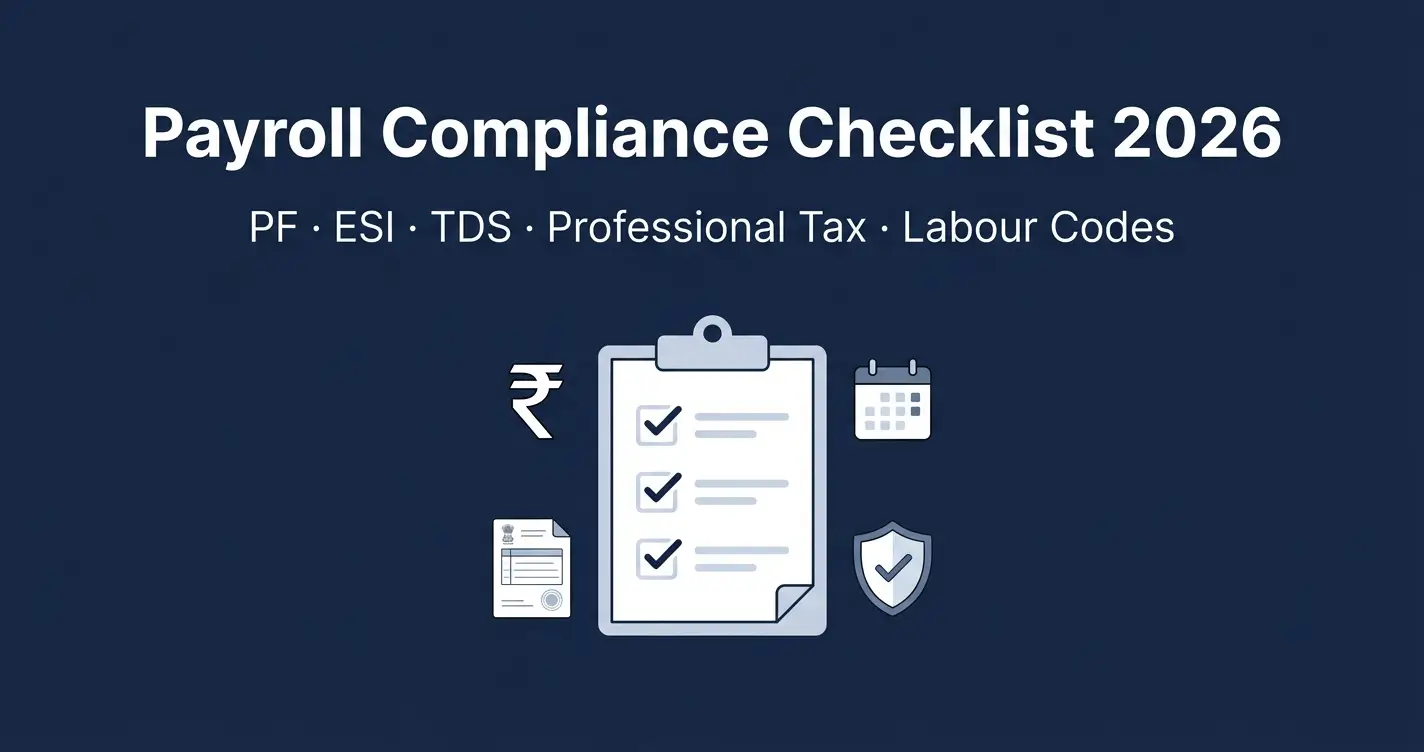
What Has Changed in 2026: The Big Picture
India’s regulatory landscape has never changed this fast. The four new Labour Codes — Code on Wages, Code on Social Security, Industrial Relations Code, and Occupational Safety, Health and Working Conditions Code — became active in November 2025. Hot on their heels, the Income Tax Act 2025 takes effect on April 1, 2026, replacing the Income Tax Act of 1961 that governed payroll for over six decades.
If you run a business in India with even a single employee, this is the most important compliance update you need to act on — right now. Missing a deadline, miscalculating a deduction, or failing to maintain the right records can mean penalties of up to Rs 50,000, legal notices, and being added to the government’s default employer list.
The Four Labour Codes (Active Since November 2025)
The Ministry of Labour & Employment consolidated 29 old labour laws into four unified codes. Here is what they mean for your payroll:
- Code on Wages: Basic pay (including Dearness Allowance) must now be at least 50% of total CTC. This fundamentally changes how salary structures are designed and directly impacts PF and gratuity calculations.
- Code on Social Security: Expands the definition of ’employee’ to include gig and platform workers in certain categories, and updates the framework for PF, ESI, and gratuity.
- Industrial Relations Code: Changes rules around standing orders, retrenchment, and layoffs — with direct HR and payroll implications for final settlements.
- Occupational Safety, Health and Working Conditions Code: Mandates digital record-keeping for attendance, wages, and statutory registers.
The Income Tax Act 2025 (Effective April 1, 2026)
The new Income Tax Act 2025 replaces the 64-year-old Income Tax Act 1961. For payroll, the key changes are:
- TDS calculation methods and reporting formats are being realigned under new IT Rules.
- Form 24Q and Form 16 generation must adhere to revised formats.
- Stricter audit scrutiny means payroll data must be traceable, structured, and audit-ready.
- Final settlement of all wages on separation must happen within two working days of an employee’s exit.
The Complete Payroll Compliance Checklist 2026
1. Provident Fund (PF) Compliance
PF remains one of the most scrutinised statutory deductions. Here is what you must ensure:
- Contribution rate: Employee contributes 12% of basic wage; employer contributes 12% (of which 8.33% goes to EPS and 3.67% to EPF).
- Due date: Deposits must be made by the 15th of the following month. Delays attract 12% interest plus damages up to 25%.
- ECR filing: Electronic Challan cum Return (ECR) must be filed monthly with EPFO.
- New wage code impact: With the 50% basic wage rule, your PF contribution base will likely increase if your current basic is less than 50% of CTC. Recalculate all employee PF contributions now.
- Annual return: File annual PF return to reconcile all contributions with EPFO records.
2. ESI (Employee State Insurance) Compliance
- Applicability: Applies to employees earning up to Rs 21,000/month (Rs 25,000 for persons with disability).
- Contribution rate: Employer pays 3.25% of gross wages; employee pays 0.75%.
- Due date: Must be deposited by the 15th of the following month.
- Coverage: Under the new Labour Codes, ESI coverage has expanded to all geographic areas of India. Verify whether your location was previously exempt.
- Annual return: File annual ESI return — ensure all eligible employees are covered and contributions are reconciled.
3. TDS on Salary (Under Income Tax Act 2025)
- Calculation: Calculate TDS based on each employee’s chosen tax regime (old or new) and their investment declarations.
- Deposit due date: 7th of the following month (for months other than March); 30th April for the month of March.
- Form 24Q: File quarterly TDS return. Q1: July 31 | Q2: October 31 | Q3: January 31 | Q4: May 31.
- Form 16: Issue to all employees by June 15 annually. Under the new Income Tax Act 2025, ensure the format aligns with revised IT Rules.
- New act impact: Review TDS calculation software compatibility with new Form 24Q formats and revised tax slabs under Income Tax Act 2025.
4. Professional Tax (PT) Compliance
Professional Tax is a state-level levy. Rates and due dates vary by state. Key obligations:
- Register with the respective state authority where employees are based.
- Deduct PT from employee salaries as per the state slab.
- Deposit and file returns as per state-specific monthly or quarterly deadlines.
- Maintain separate PT records for each state if you have multi-location employees.
5. Labour Welfare Fund (LWF)
- Applicable in states including Maharashtra, Karnataka, Gujarat, Tamil Nadu, and others.
- Contribution amounts and frequencies (monthly, half-yearly, or annual) vary by state.
- Employer and employee both contribute — check your state’s current LWF schedule.
6. Gratuity Provisions
- Eligibility: Employees completing 5 years of continuous service (reduced to 1 year for fixed-term employees under 2025 reforms).
- Calculation: 15/26 x last drawn basic salary x years of service.
- Provision: Build monthly gratuity provisions in your payroll to avoid cash flow shocks at separation.
- F&F settlement: Under the new Labour Codes, all wages on separation must be settled within two working days.
Monthly Payroll Compliance Calendar 2026
Use this as your monthly checklist template:
| Due Date | Compliance Task | Authority |
| 7th of month | Deposit TDS on salary | CBDT / IT Dept |
| 10th of month | Pay employee salaries | As per Wage Code |
| 15th of month | Deposit PF contributions + ECR filing | EPFO |
| 15th of month | Deposit ESI contributions | ESIC |
| State-specific | Deposit Professional Tax | State Authority |
| State-specific | Labour Welfare Fund deposit | State Authority |
| Quarterly | File Form 24Q (TDS return) | CBDT |
| June 15 annually | Issue Form 16 to employees | CBDT |
| July 15 annually | File FLA Return (if foreign investment) | RBI (FIRMS Portal) |
| December 31 | File Annual Performance Report (if ODI) | RBI |
Key Digital Record-Keeping Requirements in 2026
The November 2025 Labour Codes mandate fully digitalised records. Every employer must maintain:
- Employee wage registers and attendance records in digital format.
- PF, ESI, LWF contribution records — month-wise, employee-wise.
- Payslips with mandatory information: gross wages, tax deductions, and all statutory contributions.
- Statutory registers as required under the applicable Labour Code.
- TDS working sheets and Form 16 copies for a minimum of 7 years.
Common Payroll Compliance Mistakes to Avoid
- Keeping basic pay below 50% of CTC to reduce PF — this is now non-compliant under the Wage Code.
- Delaying F&F settlement beyond two working days (new two-day rule under Labour Codes).
- Not updating payroll software to generate Form 24Q in the revised format under Income Tax Act 2025.
- Ignoring state-specific PT deadlines for multi-location companies.
- Failing to file Annual Performance Reports (APR) for overseas subsidiaries by December 31.
- Not building monthly gratuity provisions, leading to cash flow issues at exit.
How AccounTX Can Help
Managing payroll compliance in India across PF, ESI, TDS, PT, and the new Labour Codes requires specialist knowledge and constant tracking of regulatory updates. AccounTX’s dedicated HR and payroll services team handles end-to-end statutory compliance for businesses of all sizes — from startups to multi-location enterprises.
We also assist with company incorporation and registration, entity secretarial compliances, and accounting and bookkeeping services — so your books, payroll, and compliance stay aligned.
Ready to get compliant? Talk to AccounTX’s payroll compliance experts today. We’ll audit your current payroll structure against the new Labour Code requirements and Income Tax Act 2025 — and fix what needs fixing before penalties hit.
Disclaimer: The information provided in this article is for general informational purposes only and does not constitute legal, tax, financial, or professional advice. While we have made every effort to ensure the accuracy of the content at the time of publication, laws, regulations, and compliance requirements are subject to change. Readers are advised to consult a qualified legal, tax, or compliance professional before making any business decisions based on the information contained herein. AccounTX shall not be held liable for any errors, omissions, or outcomes arising from the use of this information.