
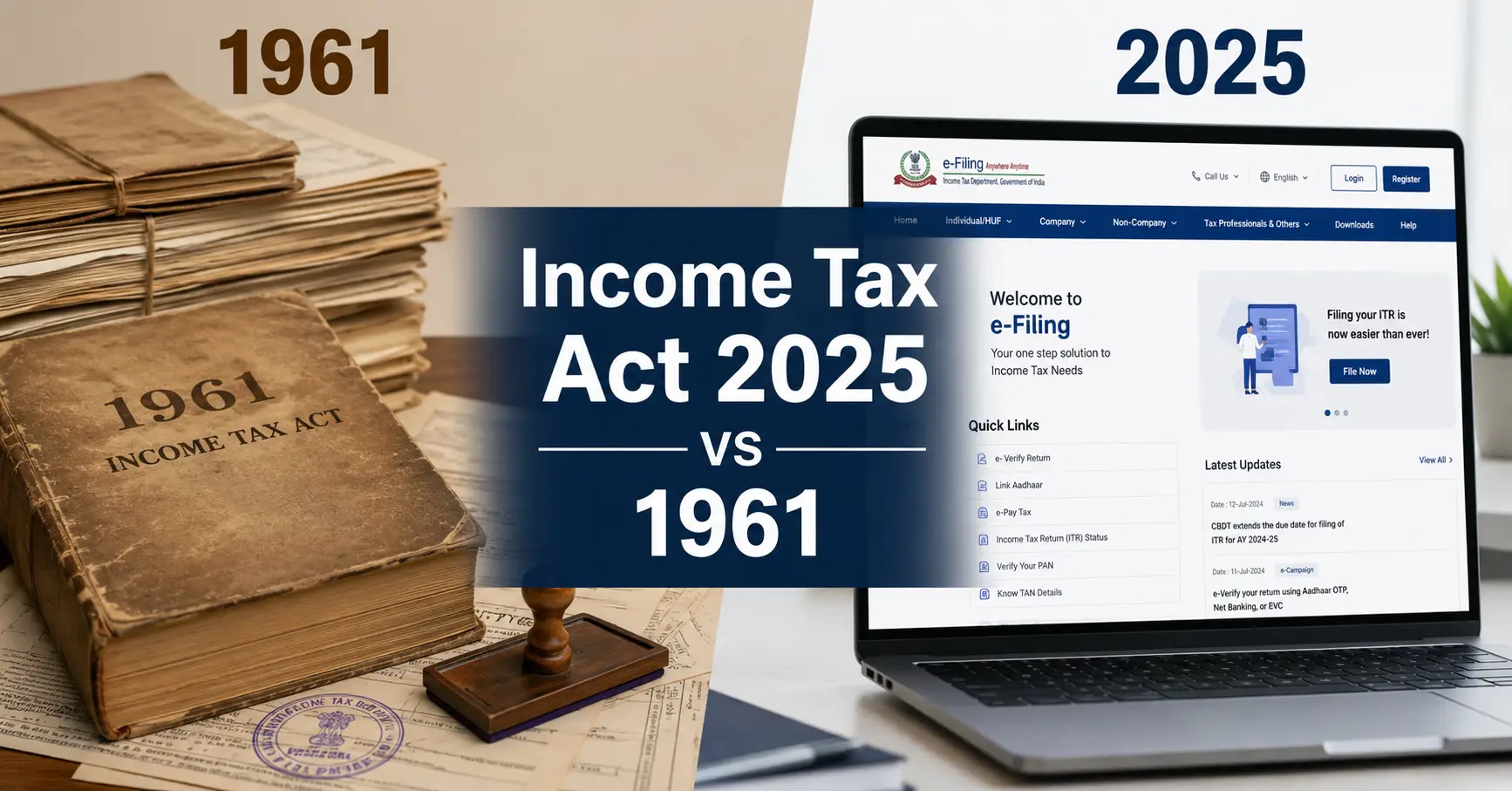
This blog breaks down the key differences between the Income Tax Act 2025 and the Income Tax Act 1961, what stays the same, and what you need to prepare for — whether you are filing individual income tax returns, managing payroll compliance, or running a business in India.
1. Why Was a New Income Tax Act Needed?
The Income Tax Act 1961 has served India for more than 63 years. Over this period, it was amended thousands of times through Annual Finance Acts, budget announcements, judicial interpretations, and CBDT circulars. The result? A complex, bulky, and often contradictory law that even seasoned tax professionals found difficult to navigate.
The government’s core objectives behind introducing the new Income Tax Act 2025 are:
- Simplification: Replace legal jargon with plain, understandable language.
- Reduction in litigation: Remove ambiguity that leads to prolonged tax disputes.
- Digital-first approach: Align the law with India’s growing digital economy.
- Structural coherence: Reorganise the law into a logical, reader-friendly format.
- Taxpayer ease: Make self-compliance easier for individuals and businesses.
A review committee was set up, and after extensive consultation, the Income Tax Bill 2025 was tabled in Parliament. It is expected to be fully effective from Assessment Year 2026–27 (i.e., Financial Year 2025–26 onwards).
2. Structural Changes: Shorter, Simpler, Smarter
One of the most visible changes in the new Income Tax Act 2025 is its dramatically reduced size and improved structure.
| Parameter | Income Tax Act 1961 | Income Tax Act 2025 |
| Total Sections / Clauses | 819 Sections | 536 Clauses |
| Chapters | 47 Chapters | 23 Chapters |
| Schedules | 14 Schedules | 16 Schedules |
| Words | ~5.12 Lakh Words | ~2.60 Lakh Words (~49% reduction) |
| Provisos | Over 1,200 Provisos | Significantly reduced |
| Explanations | ~900 Explanations | Rationalised and merged |
| Language | Complex legal language | Plain English; tabular format |
The new act uses tables, formulas, and structured layouts extensively, replacing long-winded prose and nested provisos. For example, TDS rate schedules are now presented in clean tables instead of scattered across dozens of sections.
3. New Concept: “Tax Year” Replaces “Previous Year” and “Assessment Year”
This is one of the most impactful — and welcome — changes in the Income Tax Act 2025.
Under the old Income Tax Act 1961, taxpayers had to deal with two separate concepts:
- Previous Year (PY): The financial year in which income is earned (e.g., April 1, 2024 – March 31, 2025).
- Assessment Year (AY): The year in which that income is assessed and tax is paid (e.g., April 1, 2025 – March 31, 2026).
This dual-year system caused widespread confusion, especially for first-time taxpayers and businesses filing their income tax returns.
The new Income Tax Act 2025 introduces a single concept: “Tax Year.” The Tax Year is simply the financial year in which income is earned and assessed. This aligns India’s tax system with global practices followed in the USA, UK, and most other countries.
For example: Income earned between April 1, 2025 and March 31, 2026 will now be referred to as Tax Year 2025–26 — no separate assessment year needed.
4. Income Tax Slabs: What Has Changed?
The new act does not drastically overhaul income tax rates, but it consolidates and clarifies the new tax regime (introduced in 2020) as the default regime. The old tax regime (with exemptions and deductions) remains available as an option for those who prefer it.
New Tax Regime Slabs (Default — FY 2025–26 onwards)
| Annual Income (₹) | Tax Rate |
| Up to ₹3,00,000 | Nil |
| ₹3,00,001 – ₹7,00,000 | 5% |
| ₹7,00,001 – ₹10,00,000 | 10% |
| ₹10,00,001 – ₹12,00,000 | 15% |
| ₹12,00,001 – ₹15,00,000 | 20% |
| Above ₹15,00,000 | 30% |
Key relief: Under the new regime, individuals with income up to ₹12 lakh per annum are effectively tax-free (due to tax rebate under Section 87A equivalent in the new act). This is a major benefit for the salaried middle class.
Additionally, the new act increases the standard deduction for salaried employees to ₹75,000 (up from ₹50,000), further reducing the effective tax burden.
5. Deductions and Exemptions: A Streamlined Approach
Under the Income Tax Act 1961, deductions were scattered across dozens of sections — Section 80C, 80D, 80G, 80TTA, 80TTB, 10(14), 24, and many more. Navigating these required expert knowledge of tax law, making tax filing complex for ordinary taxpayers.
The Income Tax Act 2025 takes a consolidated approach:
- All salary-related deductions and exemptions are grouped under a single chapter — making payroll and salary income tax filing much more straightforward.
- Deductions for house property, capital gains, and business income are reorganised into clearly defined chapters with tabular formats.
- The concept of “Deductions from Gross Total Income” (equivalent to the old Chapter VI-A) is retained but significantly simplified.
- Many tax exemptions available under the old regime are subsumed into the new regime’s standard deduction and rebate framework.
For businesses, especially those relying on professional accounting and bookkeeping services, this simplification means cleaner books and fewer reconciliation headaches during income tax return filing.
6. TDS and TCS Provisions: Finally Simplified
Tax Deducted at Source (TDS) and Tax Collected at Source (TCS) provisions under the Income Tax Act 1961 were spread across Sections 192 to 206CCA — a maze of rates, thresholds, and exceptions.
The Income Tax Act 2025 consolidates all TDS and TCS provisions into a single, unified schedule. Key improvements include:
- All TDS rates, applicable thresholds, and payment types are listed in one schedule — no more hunting across multiple sections.
- TDS on salary, rent, professional fees, interest, and contractor payments are clearly separated with unambiguous rate tables.
- Provisions for non-filers (higher TDS) are retained but better defined.
- TCS on foreign remittances and luxury goods remains, with clearer compliance language.
For businesses managing payroll and salary processing, this is a significant relief. Correct TDS computation is critical — and the new act makes it considerably easier. If your business needs end-to-end support, explore AccounTX‘s HR and Payroll Services to stay fully compliant under the new tax framework.
7. Digital-First Compliance Framework
The Income Tax Act 2025 formally acknowledges and integrates India’s digital infrastructure into its compliance framework — a significant departure from the 1961 Act, which was drafted in a paper-first era.
Key digital-first features include:
- Faceless Assessments and Appeals are now legislatively embedded (they were earlier introduced through administrative orders).
- Electronic communication is the default mode for all notices, orders, and responses — reducing personal hearings and physical paperwork.
- Pre-filled ITR forms (using data from Form 26AS, AIS, and TIS) are supported as a legal framework concept, reducing manual data entry during income tax e-filing.
- The income tax portal integration is specifically referenced, aligning the statutory framework with digital infrastructure.
- Virtual Digital Assets (VDAs / Cryptocurrency) provisions are better defined, reflecting modern economic realities.
8. Impact on Businesses and Companies
The new Income Tax Act 2025 has several implications for businesses operating in India:
Company Incorporation and Tax Planning
The corporate tax rate structure (25% for domestic companies with turnover up to ₹400 crore; 22% for new manufacturing companies under the concessional regime) is retained. However, the provisions governing business income, set-offs, and carry-forward of losses are reorganised and clarified. If you are planning to set up a business in India, understanding the tax implications from day one is critical — explore AccounTX’s Company Incorporation Services to get expert guidance.
Presumptive Taxation
Presumptive taxation provisions (for small businesses and professionals) are retained and consolidated. Threshold limits are updated to reflect current economic realities, reducing compliance burden for eligible small businesses.
Capital Gains Taxation
Capital gains provisions — one of the most complex areas of the 1961 Act — have been reorganised significantly. Short-term and long-term capital gain definitions, indexation benefits, and tax rates are presented more logically. The tax deduction provisions on reinvestment of capital gains are retained.
Transfer Pricing and International Taxation
For multinationals and companies with cross-border transactions, the transfer pricing and international taxation provisions are updated to align with OECD guidelines and BEPS (Base Erosion and Profit Shifting) frameworks.
9. Side-by-Side Comparison: Income Tax Act 2025 vs Income Tax Act 1961
| Feature | Income Tax Act 1961 | Income Tax Act 2025 |
| Year introduced | 1961 (effective 1962) | 2025 (effective FY 2026–27) |
| Language | Complex legal language | Plain language, tabular format |
| Year terminology | Previous Year + Assessment Year | Single “Tax Year” |
| Default tax regime | Old regime (with deductions) | New regime (standard deduction + rebate) |
| Standard deduction (salaried) | ₹50,000 | ₹75,000 |
| Tax-free income limit | Up to ₹5 lakh (with rebate) | Up to ₹12 lakh (with rebate) |
| TDS provisions | Spread across Sections 192–206CCA | Unified single schedule |
| Deductions | Scattered (80C, 80D, 80G, etc.) | Consolidated by income type |
| Digital compliance | Administrative orders (not in law) | Legislatively embedded |
| Faceless assessment | Via CBDT circulars | Statutory provision |
| Virtual digital assets | Added via amendment (2022) | Integrated from the start |
| Litigation risk | High (due to ambiguity) | Lower (clear language & definitions) |
10. What Stays the Same?
Despite all the changes, several foundational pillars of India’s income tax framework remain unchanged in the new Income Tax Act 2025:
- Five Heads of Income: Salary, House Property, Business/Profession, Capital Gains, and Other Sources remain the core income classification framework.
- Corporate tax rates for domestic and foreign companies remain largely the same.
- Advance tax provisions — quarterly payment schedule — are retained.
- Penalties and prosecution provisions are retained (with some consolidation).
- CBDT’s rule-making authority is preserved.
- Tax treaty provisions and double taxation avoidance agreements (DTAA) continue to operate under the same framework.
- The ITR filing process through the income tax portal remains the primary mode of return submission.
11. How to Prepare for the New Income Tax Regime
Whether you are a salaried individual, a small business owner, or a large corporation, here are actionable steps to prepare for the Income Tax Act 2025:
For Individual Taxpayers
- Understand whether the new tax regime (default) or old regime is more beneficial based on your income tax deductions and investments.
- Update your employer about your tax regime preference — this directly affects TDS on salary.
- Make the most of the income tax rebate for incomes up to ₹12 lakh under the new regime.
- Familiarise yourself with the new “Tax Year” terminology when reading notices or filing returns.
- Use the income tax calculator on the income tax portal to compare old vs. new regime tax liability.
For Businesses
- Review and update your TDS compliance processes to align with the new consolidated schedule.
- Ensure your accounting software and payroll systems are updated to reflect new provisions.
- Engage tax professionals to review existing tax positions under the new law — many provisions from the 1961 Act that were ambiguous may now have clearer interpretations.
- For companies with international operations, review transfer pricing and cross-border transaction compliance under the updated provisions.
- If you are a startup or new business, plan your tax structure from the outset under the new act to maximise available benefits.
Conclusion
The Income Tax Act 2025 is not just a cosmetic makeover of the 1961 Act — it is a fundamental rethinking of how tax law should be written and administered in a modern economy. By simplifying language, consolidating provisions, introducing the Tax Year concept, and embedding digital compliance, the new act aims to reduce the compliance burden, cut down on litigation, and make India a more business-friendly destination.
However, any major legislative change also creates a transition period of uncertainty. Understanding the nuances, adapting your tax planning strategy, and staying updated with CBDT notifications will be critical over the next few years.
At AccounTX, our expert team of chartered accountants and tax professionals is closely tracking all developments under the new act. Whether you need support with income tax return filing, corporate tax compliance, payroll management, or business setup — we are here to guide you every step of the way.
📞 Have questions about the new Income Tax Act 2025?
Get in touch with our team today for a free consultation.
Disclaimer
The information provided in this blog is intended for general informational and educational purposes only. It does not constitute professional tax, legal, or financial advice. While we have made every effort to ensure the accuracy and completeness of the content as of the date of publication, the Income Tax Act 2025 is subject to Parliamentary approval, CBDT notifications, and further amendments. Tax laws are complex and subject to change, and their applicability may vary depending on individual circumstances. Readers are strongly advised to consult a qualified chartered accountant or tax professional before making any financial or tax-related decisions. AccounTX shall not be held liable for any errors, omissions, or outcomes arising from the use of this information.