With updated income tax slabs, a higher standard deduction, a revised tax rebate, and a completely different approach to exemptions and deductions, the two regimes are fundamentally different in both structure and outcome. Choosing the wrong one could mean paying thousands – or even lakhs – more in tax than you need to.
This comprehensive guide breaks down the New Tax Regime vs Old Tax Regime for 2026, side by side – with tax slab comparisons, calculation examples, and a clear framework to help you decide which one puts more money in your pocket.
- Quick Overview: Two Regimes, One Choice
India currently operates with two parallel personal income tax structures:
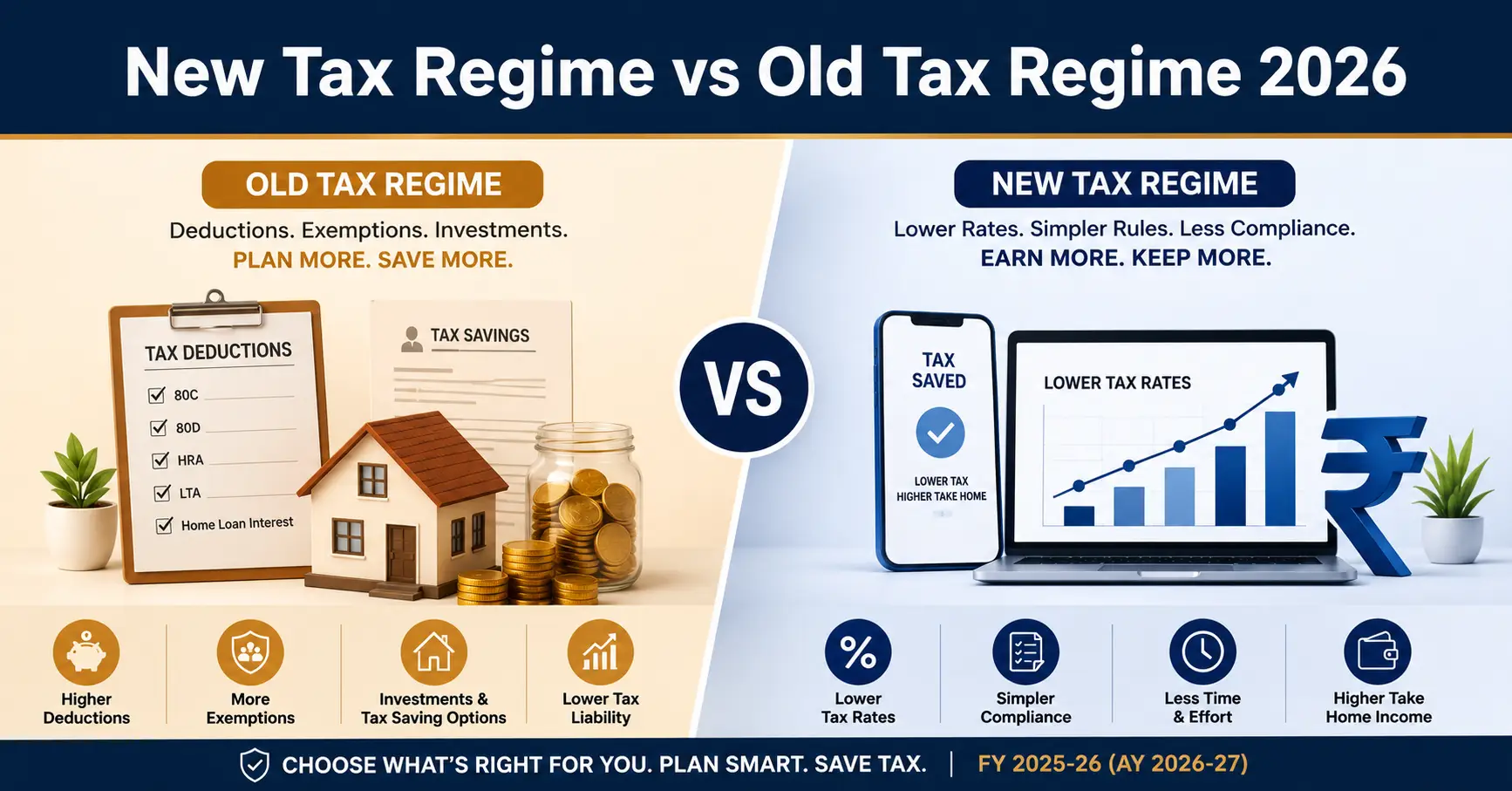
- New Tax Regime (Default from FY 2024–25 onwards): Lower, simplified tax rates. Fewer deductions and exemptions. Higher standard deduction of ₹75,000. Best suited for taxpayers who do not have large investments, loans, or insurance under the traditional tax-saving instruments.
- Old Tax Regime (Optional – must be opted in): Higher base tax rates, but allows a wide range of income tax deductions and exemptions under various sections like 80C, 80D, HRA, LTA, and more. Best suited for taxpayers with significant tax-saving investments and eligible expenditures.
The critical point for FY 2025–26 (Tax Year 2026): if you do not actively choose the old regime, you will automatically be taxed under the new regime. For salaried employees, this choice must be communicated to your employer at the start of the year – it directly affects the tax deduction on salary (TDS) every month.
2. New Tax Regime Income Tax Slabs 2026 (Default)
The new income tax slabs for FY 2025–26 under the new regime are as follows:
| Annual Taxable Income (₹) | Tax Rate |
| Up to ₹3,00,000 | Nil |
| ₹3,00,001 – ₹7,00,000 | 5% |
| ₹7,00,001 – ₹10,00,000 | 10% |
| ₹10,00,001 – ₹12,00,000 | 15% |
| ₹12,00,001 – ₹15,00,000 | 20% |
| Above ₹15,00,000 | 30% |
Key Benefits of the New Tax Regime in 2026:
- Tax Rebate u/s 87A: Individuals with taxable income up to ₹12,00,000 get a full rebate – meaning zero tax payable. This is effectively the most significant income tax rebate ever offered to the Indian middle class.
- Standard Deduction of ₹75,000 for salaried employees (up from ₹50,000 in the old regime), bringing the effective tax-free threshold to ₹12,75,000 for salaried individuals.
- No surcharge for incomes up to ₹50 lakh; a streamlined surcharge structure above that.
- Lower tax rates across most income brackets – especially beneficial for incomes between ₹7 lakh and ₹15 lakh.
3. Old Tax Regime Income Tax Slabs 2026
The old tax regime slabs remain unchanged. However, the value of this regime lies in the deductions and exemptions available – not the slab rates themselves:
| Annual Taxable Income (₹) | Tax Rate (Below 60 years) | Tax Rate (Senior Citizens 60–79 yrs) | Tax Rate (Super Senior 80+ yrs) |
| Up to ₹2,50,000 | Nil | Nil | Nil |
| ₹2,50,001 – ₹3,00,000 | 5% | Nil | Nil |
| ₹3,00,001 – ₹5,00,000 | 5% | 5% | Nil |
| ₹5,00,001 – ₹10,00,000 | 20% | 20% | 20% |
| Above ₹10,00,000 | 30% | 30% | 30% |
Note: Under the old regime, salaried individuals also get a standard deduction of ₹50,000, and the income tax rebate u/s 87A applies for taxable income up to ₹5,00,000 (after all deductions).
4. Key Differences: New Tax Regime vs Old Tax Regime
| Feature | New Tax Regime (2026) | Old Tax Regime (2026) |
| Default Status | ✅ Default (auto-applied) | ❌ Must be opted in |
| Basic Exemption Limit | ₹3,00,000 | ₹2,50,000 (₹3L for Senior Citizens) |
| Tax-Free Income (with rebate) | Up to ₹12,00,000 | Up to ₹5,00,000 |
| Standard Deduction (Salaried) | ₹75,000 | ₹50,000 |
| HRA Exemption | ❌ Not available | ✅ Available |
| Section 80C Deduction (up to ₹1.5L) | ❌ Not available | ✅ Available |
| Section 80D (Health Insurance) | ❌ Not available | ✅ Available |
| Home Loan Interest (Section 24b) | ❌ Not available (self-occupied) | ✅ Up to ₹2,00,000 |
| LTA Exemption | ❌ Not available | ✅ Available |
| NPS Employer Contribution (80CCD(2)) | ✅ Available (up to 14% of salary) | ✅ Available |
| Tax Complexity | Low – simple calculation | High – requires tracking investments & proofs |
| Best For | Low-deduction taxpayers; income ≤ ₹12L | High-deduction taxpayers; income > ₹15L with large investments |
5. Deductions and Exemptions in the Old Tax Regime
The old regime’s primary advantage is its rich set of income tax deductions and tax exemptions. Here is a summary of the most impactful ones:
Chapter VI-A Deductions (from Gross Total Income)
| Section | Type of Deduction | Maximum Limit |
| 80C | EPF, PPF, ELSS, Life Insurance, NSC, Home Loan Principal, Children’s Tuition Fees, 5-yr FD | ₹1,50,000 |
| 80CCD(1B) | Additional NPS contribution (self) | ₹50,000 |
| 80D | Health Insurance Premium (self + family + parents) | Up to ₹75,000 |
| 80E | Education Loan Interest | No upper limit (for 8 years) |
| 80G | Charitable Donations | 50%–100% of donation amount |
| 80TTA / 80TTB | Interest on Savings / Deposits (Senior Citizens) | ₹10,000 / ₹50,000 |
| 24(b) | Home Loan Interest (self-occupied property) | ₹2,00,000 |
| Section 10(13A) | HRA Exemption | Based on actual rent, salary, and city |
If you are actively investing in tax-saving instruments, holding a home loan, and paying rent, the total tax deduction available in the old regime can be ₹3.5 lakh to ₹5 lakh or more – significantly reducing your taxable income.
6. What Deductions Do You Get in the New Tax Regime?
The new tax regime is intentionally lean on deductions. However, it is not entirely bare. Here is what remains available:
- Standard Deduction of ₹75,000 (for salaried employees and pensioners)
- Employer’s NPS Contribution (Section 80CCD(2)): Up to 14% of basic salary for central government employees; 10% for others
- Family Pension Standard Deduction: Lower of ₹25,000 or one-third of pension
- Conveyance and travel allowances for physically disabled employees
- VRS compensation up to ₹5 lakh (Section 10(10C))
- Gratuity and Leave Encashment exemptions (on retirement) remain applicable
- Agricultural income continues to remain exempt
What is not available in the new regime: HRA, LTA, Section 80C, 80D, 80E, 80G, home loan interest deduction on self-occupied property, and most other Chapter VI-A deductions.
7. Tax Calculation Example: New Regime vs Old Regime (FY 2025–26)
Let us compare the tax on salary for a salaried individual with an annual income of ₹15,00,000 under both regimes:
Assumptions (Old Regime):
- HRA Exemption: ₹1,20,000
- Section 80C: ₹1,50,000 (EPF + ELSS + LIC)
- Section 80D: ₹25,000 (Health Insurance)
- Home Loan Interest (Section 24b): ₹2,00,000
- Standard Deduction: ₹50,000
| Particulars | New Tax Regime (₹) | Old Tax Regime (₹) |
| Gross Annual Income | 15,00,000 | 15,00,000 |
| Standard Deduction | (75,000) | (50,000) |
| HRA Exemption | Not Available | (1,20,000) |
| Section 80C | Not Available | (1,50,000) |
| Section 80D | Not Available | (25,000) |
| Home Loan Interest (24b) | Not Available | (2,00,000) |
| Net Taxable Income | 14,25,000 | 9,55,000 |
| Income Tax (before cess) | ~₹1,73,750 | ~₹1,12,500 |
| Health & Education Cess (4%) | ~₹6,950 | ~₹4,500 |
| Total Tax Payable | ~₹1,80,700 | ~₹1,17,000 |
| Tax Saving | – | ~₹63,700 savings with Old Regime |
In this example, the old tax regime saves approximately ₹63,700 due to significant deductions. However, for an individual with no home loan, no HRA, and minimal 80C investments, the new regime would be far more beneficial.
The breakeven point – where both regimes result in the same tax – depends entirely on your total eligible deductions. Use an income tax calculator or consult a tax professional to find your personal breakeven figure.
8. Impact on Salaried Employees
For salaried professionals, the regime choice directly affects the monthly TDS on salary. Here is what you need to know for FY 2025–26:
- Declare your regime at the start of the year: Inform your employer (typically via the HR/payroll system) which regime you want. If you do not declare, the new regime is automatically applied.
- New regime advantage for lower incomes: Salaried employees earning up to ₹12,75,000 annually (₹12L + ₹75K standard deduction) effectively pay zero income tax under the new regime.
- Old regime advantage for active investors: If you are contributing to EPF, PPF, ELSS, and paying health insurance premiums and home loan EMIs, the old regime’s deductions can bring down your taxable income substantially.
- You can switch at the time of ITR filing: Salaried employees (not having business income) can choose a different regime while filing their income tax return, even if they declared a different choice to their employer during the year.
Proper payroll compliance is critical for businesses to ensure the correct TDS is deducted. AccountX’s HR and Payroll Services ensure that your salary processing, TDS calculation, and Form 16 generation are fully accurate and compliant under the regime chosen by your employees.
9. Senior Citizens: Special Provisions in Both Regimes
Senior citizens (aged 60–79) and super senior citizens (80+) have certain advantages that vary between regimes:
Under the Old Tax Regime:
- Higher basic exemption limit: ₹3,00,000 for senior citizens; ₹5,00,000 for super senior citizens.
- Senior citizen tax exemption on FD/savings interest: Up to ₹50,000 under Section 80TTB.
- Higher Section 80D deduction for health insurance: Up to ₹50,000 for self (vs ₹25,000 for general taxpayers).
- No advance tax liability if they have no business income.
Under the New Tax Regime:
- The basic exemption limit for all individuals – including senior citizens – is a uniform ₹3,00,000.
- Super senior citizens lose their higher exemption limit (₹5L) benefit under the new regime.
- The ₹12 lakh rebate is available to senior citizens under the new regime as well.
- 80TTB and higher 80D deductions are not available.
Verdict for Senior Citizens: Those with pension income above ₹12 lakh and substantial health insurance, FD interest, or medical expenditure are likely better off in the old regime. Those with straightforward pension income under ₹12 lakh will benefit from the new regime’s zero-tax threshold.
10. Impact on Business Owners and Freelancers
For self-employed individuals, professionals, and business owners, the regime choice has additional dimensions:
- Business owners choosing the new regime cannot switch back easily: Once a business taxpayer opts out of the new regime (i.e., into the old regime), they can only come back to the new regime once in their lifetime. This is a critical restriction that salaried individuals do not face.
- Depreciation claims are still allowed in the new regime for business assets.
- Deductions for business expenses (rent, salaries, utilities, professional fees) are available in both regimes – these are not “personal” deductions and are deducted before arriving at business income.
- Presumptive taxation (Sections 44AD and 44ADA) is available under both regimes, making compliance easier for small businesses and professionals.
For business owners managing accounts and tax filing across multiple heads of income, maintaining accurate books is non-negotiable. AccountX’s Accounting and Bookkeeping Services help you maintain clean, audit-ready financial records and optimise your tax position under whichever regime suits your business best.
11. Who Should Choose Which Regime? (Decision Framework)
✅ Choose the New Tax Regime if:
- Your gross annual income is up to ₹12,75,000 (salaried) – you will pay zero tax.
- You have minimal investments in 80C instruments (PPF, ELSS, LIC) and no home loan.
- You do not claim HRA (you live in your own home or in employer-provided accommodation).
- You want a simple, hassle-free income tax filing process without tracking multiple investment proofs.
- Your income is above ₹15 lakh and your total eligible deductions are less than ₹3.75 lakh.
- You are a young professional just starting your career with limited tax-saving investments.
✅ Choose the Old Tax Regime if:
- You actively invest in 80C instruments to the maximum (₹1.5 lakh).
- You pay HRA and are eligible for a significant HRA exemption.
- You are repaying a home loan on a self-occupied property and claiming Section 24(b) deduction.
- You pay health insurance premiums for yourself, your family, and your parents.
- You are a senior citizen with substantial FD interest income and medical expenses.
- Your total eligible deductions exceed ₹3.75 lakh to ₹5 lakh, making the old regime more tax-efficient despite higher slab rates.
12. How to Switch Between Regimes
Understanding how to switch is as important as understanding which regime to choose:
For Salaried Employees:
- Inform your employer of your regime preference at the beginning of the financial year (April).
- Your employer will apply TDS accordingly throughout the year.
- You can switch to the other regime at the time of filing your income tax return (ITR) – but note that any excess or deficit in TDS will be settled via refund or additional payment.
- Salaried individuals can switch between regimes every year.
For Business Owners / Self-Employed:
- The regime choice must be declared at the time of filing the ITR.
- Once you opt out of the new regime, you can only return to it once in your lifetime.
- Advance tax must be paid under the chosen regime throughout the year.
13. Tax Saving Tips That Work Under Both Regimes
Regardless of which regime you choose, there are certain tax saving options and strategies that benefit taxpayers across the board:
- Maximise Employer NPS Contribution (Section 80CCD(2)): This deduction is available under both regimes. Ask your employer to restructure your salary to include a higher NPS contribution – this reduces your taxable income without any personal investment effort.
- Utilise Gratuity and Leave Encashment: These retirement benefits are tax-exempt in both regimes within prescribed limits.
- Time your capital gains wisely: Long-term capital gains on equity (above ₹1.25 lakh) are taxed at 12.5% in both regimes. Consider harvesting gains strategically to stay within the exemption threshold.
- Use an income tax calculator: Before finalising your regime, use the official income tax calculator on the income tax portal or consult a tax professional to run a comparative calculation with your actual figures.
- Don’t ignore Form 12BAA: Salaried employees can now declare other income sources and tax deductions to their employer using Form 12BAA, enabling more accurate monthly TDS.
- Plan investments early in the year (if choosing old regime): Avoid the March rush – systematic monthly investments give you better returns and proper documentation.
Conclusion
The debate between the New Tax Regime vs Old Tax Regime in 2026 does not have a one-size-fits-all answer. The right choice depends entirely on your income level, investment habits, lifestyle expenses, and financial goals.
In simple terms:
- If you earn under ₹12.75 lakh and have fewer deductions → New Regime wins.
- If you earn above ₹15 lakh and have large deductions (home loan + HRA + 80C + 80D) → Old Regime likely wins.
- If you’re in between → Calculate both and compare.
With the Income Tax Act 2025 now formalising the new regime as default, the window to make an informed decision is at the start of every financial year. Do not let the default decide for you.
At AccountX, our team of expert tax professionals helps individuals, salaried employees, and businesses calculate, compare, and file under the regime that maximises their after-tax income. From payroll TDS management to ITR filing and tax planning – we handle it all.
📞 Need help deciding which regime is right for you in 2026?
Talk to our tax experts today – free initial consultation.
Disclaimer
The information provided in this blog is intended for general informational and educational purposes only and does not constitute professional tax, legal, or financial advice. While every effort has been made to ensure accuracy as of the date of publication, income tax laws, slabs, and provisions are subject to change through Finance Acts, CBDT circulars, and government notifications. Tax calculations and examples used in this article are illustrative in nature and may not reflect your specific financial situation. Individual tax liability varies based on personal circumstances, applicable exemptions, and the most current legal provisions. Readers are strongly advised to consult a qualified chartered accountant or tax professional before making any financial, investment, or tax-related decisions. AccounTX shall not be held responsible for any errors, omissions, or outcomes arising from reliance on the content of this blog.