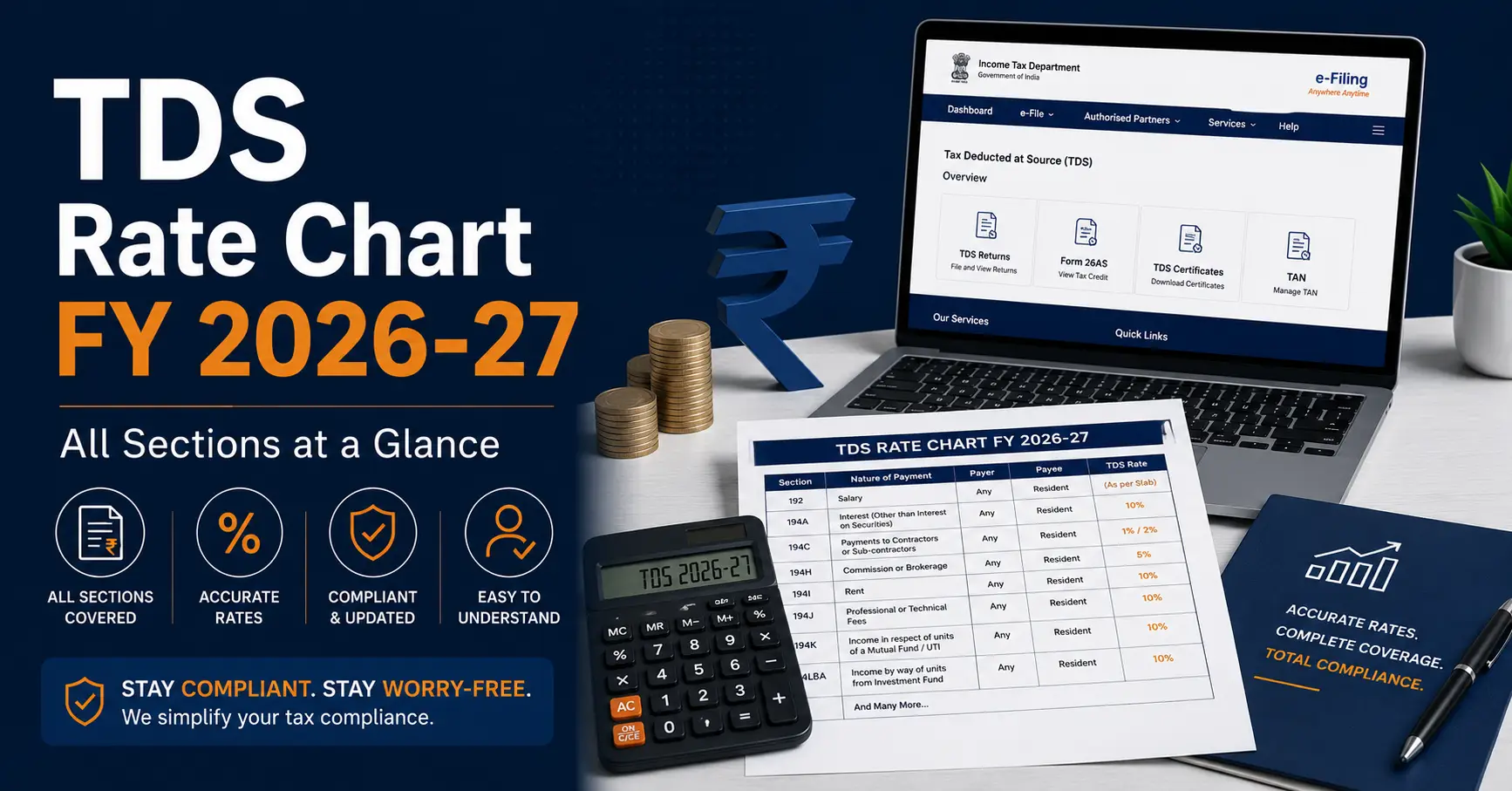
This comprehensive guide covers the complete TDS rate chart for FY 2026-27 (Assessment Year 2027-28), key thresholds, important rule changes, and practical tips to stay compliant – all in one place.
1. What Is TDS and Why Does It Matter?
TDS stands for Tax Deducted at Source. It is a mechanism under the Income Tax Act, 1961, where tax is deducted at the point of income generation – before the payment actually reaches the recipient. The person or entity making the payment (called the deductor) is responsible for deducting the applicable tax and depositing it with the Central Government within the prescribed time.
The recipient (called the deductee) gets credit for the TDS deducted against their final income tax liability when filing their income tax return.
Why Is TDS Important?
- It ensures a continuous and steady flow of tax revenue to the government throughout the year.
- It prevents tax evasion by capturing tax at the source of income itself.
- It simplifies tax compliance for deductees, as their tax obligation is partially met throughout the year.
- For businesses, incorrect TDS deduction or non-deposit leads to disallowance of the related expense under Section 40(a)(ia) of the Income Tax Act – a significant financial risk.
Simply put, if you are making any payment covered under the TDS provisions and you fail to deduct tax correctly, the entire expense can be disallowed in your tax return – increasing your taxable income substantially.
2. Key TDS Terminology You Must Know
| Term | Meaning |
| Deductor | The person or entity responsible for deducting TDS before making payment |
| Deductee | The person receiving the payment (whose tax is being deducted) |
| TAN | Tax Deduction and Collection Account Number – mandatory for all deductors |
| PAN | Permanent Account Number – if the deductee does not furnish PAN, TDS is deducted at a higher rate (20%) |
| Threshold Limit | The minimum payment amount below which TDS is not required to be deducted |
| Assessment Year (AY) | The year in which income earned in the previous financial year is assessed. FY 2026-27 → AY 2027-28 |
| Form 26AS / AIS | Tax passbook / Annual Information Statement – reflects all TDS deducted against a taxpayer’s PAN |
| Challan 281 | The government challan used to deposit TDS amounts to the Income Tax Department |
3. TDS Rate Chart for FY 2026-27 (AY 2027-28) – All Sections
The following table provides the comprehensive TDS rate chart for FY 2026-27 covering all major sections of the Income Tax Act applicable to resident deductees. Rates for non-residents are covered separately in Section 6.
Note: Surcharge and Health & Education Cess are NOT applicable on TDS deductions (except for salary income and payments to non-residents).
| Section | Nature of Payment | Threshold Limit (₹) | TDS Rate – Individual / HUF | TDS Rate – Others (Companies, Firms, etc.) |
| 192 | Salary income | Basic exemption limit | As per applicable income tax slab rates | As per applicable slab rates |
| 192A | Premature withdrawal from EPF (Employee Provident Fund) | ₹50,000 | 10% | 10% |
| 193 | Interest on securities (debentures, government securities) | ₹10,000 | 10% | 10% |
| 194 | Dividend (from domestic companies) | ₹5,000 | 10% | 10% |
| 194A | Interest other than interest on securities (e.g., bank FD interest) | ₹50,000 (senior citizens) / ₹40,000 (banks) / ₹5,000 (others) | 10% | 10% |
| 194B | Winnings from lottery, crossword puzzles, card games | ₹10,000 per transaction | 30% | 30% |
| 194BA | Winnings from online games | No threshold (net winnings) | 30% | 30% |
| 194BB | Winnings from horse races | ₹10,000 | 30% | 30% |
| 194C | Payments to contractors / sub-contractors | ₹30,000 (single) / ₹1,00,000 (aggregate in FY) | 1% | 2% |
| 194D | Insurance commission | ₹15,000 | 5% | 10% |
| 194DA | Payment in respect of life insurance policy | ₹1,00,000 | 5% | 5% |
| 194E | Payments to non-resident sportsmen or sports association | No threshold | 20% | 20% |
| 194EE | Payment from National Savings Scheme (NSS) | ₹2,500 | 10% | 10% |
| 194F | Payment on repurchase of units by mutual fund / UTI | No threshold | 20% | 20% |
| 194G | Commission on sale of lottery tickets | ₹15,000 | 5% | 5% |
| 194H | Commission or brokerage (other than insurance commission) | ₹15,000 | 5% | 5% |
| 194I(a) | Rent – plant, machinery, or equipment | ₹2,40,000 per year | 2% | 2% |
| 194I(b) | Rent – land, building, or furniture | ₹2,40,000 per year | 10% | 10% |
| 194IA | Transfer of immovable property (other than agricultural land) | ₹50,00,000 | 1% | 1% |
| 194IB | Rent paid by individual / HUF (not covered under 194I) | ₹50,000 per month | 5% | N/A |
| 194IC | Payment under Joint Development Agreement | No threshold | 10% | 10% |
| 194J(a) | Fees for technical services / royalty for sale of software | ₹30,000 | 2% | 2% |
| 194J(b) | Fees for professional services / royalty / non-compete fees / director fees | ₹30,000 | 10% | 10% |
| 194K | Income from units of mutual fund | ₹5,000 | 10% | 10% |
| 194LA | Compensation for compulsory acquisition of immovable property | ₹2,50,000 | 10% | 10% |
| 194LB | Interest from infrastructure debt fund | No threshold | 5% | 5% |
| 194LBA(1) | Distribution from business trust (interest / dividend component) | No threshold | 10% | 10% |
| 194LC | Interest from foreign currency bonds / GDRs (to non-residents) | No threshold | 5% | 5% |
| 194LD | Interest on government securities / rupee-denominated bonds to FII / QFI | No threshold | 5% | 5% |
| 194M | Payment by certain individuals / HUF to contractors or professionals | ₹50,00,000 per year | 5% | N/A |
| 194N | Cash withdrawal from banks / post offices exceeding threshold | ₹1 crore (general) / ₹20 lakh (if ITR not filed for 3 years) | 2% / 5% | 2% / 5% |
| 194O | Payments by e-commerce operators to participants | ₹5,00,000 (for individual / HUF) | 1% | 1% |
| 194P | TDS on senior citizens (75+) with pension & interest from same bank | As per slab | As per applicable slab rates | N/A |
| 194Q | Payment to resident seller for purchase of goods | ₹50 lakh per year | 0.1% | 0.1% |
| 194R | Benefits or perquisites in respect of business / profession | ₹20,000 per year | 10% | 10% |
| 194S | Payment for transfer of virtual digital assets (VDA / Crypto) | ₹50,000 (specified persons) / ₹10,000 (others) | 1% | 1% |
| 194T | Payment to partners of a firm (salary, bonus, commission, interest) | ₹20,000 per year | 10% | 10% |
Important: The above rates apply when the deductee furnishes a valid PAN. If PAN is not provided, TDS is applicable at 20% or the above rate – whichever is higher – under Section 206AA.
Managing TDS compliance across multiple sections can be complex. AccounTX’s team of expert chartered accountants provides comprehensive corporate tax and GST compliance services to ensure your TDS deductions, deposits, and return filings are always accurate and timely.
4. TDS on Salary (Section 192) – Explained in Detail
TDS on salary under Section 192 is perhaps the most widely applicable TDS provision in India – it affects every employer and salaried employee. Unlike other TDS sections that have fixed rates, TDS on salary is deducted based on the employee’s applicable income tax slab rate for the financial year.
How Is TDS on Salary Calculated?
The employer must estimate the total salary income of the employee for the financial year, deduct the eligible exemptions and deductions (HRA, Standard Deduction, 80C investments, etc.), and then apply the applicable slab rates to arrive at the tax liability. This is then divided by 12 to determine the monthly TDS to be deducted.
Income Tax Slab Rates for FY 2026-27 (New Tax Regime – Default)
| Annual Income Slab | Tax Rate (New Regime) |
| Up to ₹3,00,000 | Nil |
| ₹3,00,001 – ₹7,00,000 | 5% |
| ₹7,00,001 – ₹10,00,000 | 10% |
| ₹10,00,001 – ₹12,00,000 | 15% |
| ₹12,00,001 – ₹15,00,000 | 20% |
| Above ₹15,00,000 | 30% |
Note: Under the new tax regime, the basic exemption limit is ₹3 lakh and a standard deduction of ₹75,000 is available for salaried individuals. The tax rebate under Section 87A means individuals with net taxable income up to ₹7 lakh effectively pay zero tax under the new regime.
Employers must also add a 4% Health and Education Cess and applicable surcharge while calculating TDS on salary – unlike other TDS sections where cess and surcharge are generally not added (except for non-residents).
For businesses with growing headcounts, managing monthly payroll and TDS compliance accurately requires a structured system. AccounTX offers dedicated HR and payroll services that handle everything from salary structuring to TDS computation and Form 24Q filings.
5. When Is TDS Deducted at a Higher Rate?
There are specific situations where TDS must be deducted at a rate higher than the standard rate prescribed in the TDS rate chart. These are governed by Sections 206AA and 206AB of the Income Tax Act.
Section 206AA – Non-furnishing of PAN
If the deductee fails to provide their Permanent Account Number (PAN) to the deductor, TDS must be deducted at the higher of the following:
- The rate specified in the relevant TDS section
- At the rate of 20%
This provision applies to all TDS sections and is a significant reason why sharing PAN details is critical for all vendors, contractors, and service providers.
Section 206AB – Non-filers of Income Tax Return
Introduced to incentivise ITR filing, Section 206AB requires higher TDS deduction for “specified persons” – those who have not filed their income tax returns for the two preceding financial years and whose TDS/TCS in each of those years was ₹50,000 or more.
For such persons, TDS is deducted at the higher of the following:
- Twice the rate specified in the relevant TDS section
- Twice the rate or rates in force
- 5%
Deductors can verify a payee’s ITR-filing status using the Compliance Check functionality available on the income tax e-filing portal (incometax.gov.in).
6. TDS on Payments to NRIs – Section 195
When any person (resident or non-resident) makes a payment to a Non-Resident Indian (NRI) or a foreign company that is chargeable to tax in India, TDS must be deducted under Section 195.
Key points about Section 195:
- There is no specific threshold limit – TDS applies to the entire sum if it is chargeable to tax in India.
- The rate of TDS depends on the nature of income and the applicable Double Tax Avoidance Agreement (DTAA) between India and the NRI’s country of residence, whichever is more beneficial.
- Standard rates under Section 195 (without DTAA benefit) include: interest income (20%), royalties and fees for technical services (10%), long-term capital gains (10% or 20% depending on asset type), and other income (30%).
- An NRI can apply for a lower or nil deduction certificate from the Assessing Officer under Section 197, which can reduce the TDS burden significantly.
- Surcharge and Health & Education Cess (4%) are applicable on TDS for non-residents, unlike resident TDS in most sections.
If your business regularly makes payments to foreign vendors, NRI partners, or offshore entities, it is strongly recommended to consult a tax expert to determine the correct TDS rate after considering applicable DTAA provisions.
7. TDS Return Filing: Due Dates & Forms for FY 2026-27
Every deductor is required to file quarterly TDS returns with the Income Tax Department, reporting all TDS deductions made during the quarter. Timely TDS return filing ensures that deductees can see the TDS credit in their Form 26AS / AIS and claim it while filing their income tax return.
TDS Payment Due Dates (Deposit of Tax Deducted)
| Month of Deduction | Due Date for Deposit |
| April to February | 7th of the following month |
| March | 30th April |
| Property purchase (Section 194IA, 194IB, 194M) | 30 days from end of the month of deduction |
Quarterly TDS Return Filing Due Dates – FY 2026-27
| Quarter | Period | Due Date (Form 24Q / 26Q / 27Q) |
| Q1 | April – June 2026 | 31st July 2026 |
| Q2 | July – September 2026 | 31st October 2026 |
| Q3 | October – December 2026 | 31st January 2027 |
| Q4 | January – March 2027 | 31st May 2027 |
Which TDS Return Form to Use?
| Form | Applicable For |
| Form 24Q | TDS on salary payments (Section 192) |
| Form 26Q | TDS on all non-salary payments to residents |
| Form 27Q | TDS on payments to non-residents (other than salary) |
| Form 27EQ | TCS (Tax Collected at Source) returns |
TDS returns must be filed through the TRACES portal (tdscpc.gov.in) or authorised e-TDS intermediaries. AccounTX handles complete tax registration, TAN application, and TDS compliance for newly incorporated companies and established businesses alike.
8. TDS Certificate: Form 16 & Form 16A
Once TDS is deducted and the return is filed, the deductor is required to issue a TDS certificate to the deductee. This certificate is proof that tax has been deducted and deposited on the deductee’s behalf.
| Certificate | Applicable For | Issued By | Due Date of Issuance |
| Form 16 | TDS on salary (Section 192) | Employer | 15th June after the end of the financial year |
| Form 16A | TDS on non-salary payments (all other sections) | Deductor (company/individual) | 15 days from the due date of filing TDS return for that quarter |
| Form 16B | TDS on sale of property (Section 194IA) | Buyer of property | 15 days from the due date of deposit |
| Form 16C | TDS on rent paid by individual/HUF (Section 194IB) | Tenant | 15 days from the due date of deposit |
Deductees must always cross-check TDS certificates against their Form 26AS and Annual Information Statement (AIS) on the income tax portal to ensure there are no discrepancies before filing their income tax return (ITR).
9. Consequences of TDS Non-Compliance in FY 2026-27
TDS compliance is not optional – failures attract severe financial and legal penalties. Here is what you need to know:
Interest for Non-Deduction or Late Deduction
- Failure to deduct TDS: Interest at 1% per month (or part thereof) from the date TDS was deductible to the date of actual deduction.
- Failure to deposit TDS after deduction: Interest at 1.5% per month (or part thereof) from the date of deduction to the date of actual deposit.
Penalty for Late Filing of TDS Return – Section 234E
A fee of ₹200 per day is levied for each day of delay in filing the TDS return, from the due date until the return is actually filed. The total fee cannot exceed the total TDS amount reported in the return.
Penalty for Non-Filing or Incorrect Filing – Section 271H
In addition to the Section 234E fee, the Assessing Officer may impose a penalty ranging from ₹10,000 to ₹1,00,000 for failure to file TDS returns or for providing incorrect information in the return.
Disallowance of Business Expenditure – Section 40(a)(ia)
If TDS is not deducted on payments covered under TDS provisions, 30% of the related expense is disallowed while computing taxable income. This is one of the most financially damaging consequences of TDS non-compliance for businesses.
Prosecution Risk
In cases of wilful failure to deposit TDS with the government after it has been deducted – which effectively constitutes using government tax money for private purposes – prosecution under Section 276B is possible, with imprisonment ranging from 3 months to 7 years along with a fine.
10. Lower or Zero TDS Deduction Certificate – Section 197
If a deductee believes their actual tax liability for the year will be lower than the TDS being deducted, they can apply to their jurisdictional Assessing Officer for a Lower Deduction Certificate (LDC) under Section 197.
Once granted, the deductor is authorised to deduct TDS at the lower rate or at nil rate as specified in the certificate. This helps improve cash flow for businesses and individuals who are regularly subject to high TDS deductions.
How to Apply for a Lower TDS Certificate
- Application is made online through the TRACES portal using Form 13.
- Supporting documents such as projected income, tax computation, and past ITR filings must be submitted.
- The certificate is valid for the financial year specified and must be renewed annually.
- Sections covered include 192, 193, 194, 194A, 194C, 194D, 194G, 194H, 194I, 194J, 194K, 194LA, 195, and others.
Note: A nil TDS certificate does not mean the income is exempt from tax – it simply means TDS need not be deducted at source. The deductee is still required to include that income in their income tax return and pay any applicable tax.
Frequently Asked Questions on TDS Rates FY 2026-27
Q1. What is the TDS rate for professional fees in FY 2026-27?
TDS on professional fees is deducted under Section 194J(b) at 10% for fees paid to professionals such as doctors, lawyers, chartered accountants, architects, and consultants, provided the payment exceeds ₹30,000 in a financial year. Technical services (Section 194J(a)) attract a lower rate of 2%.
Q2. Is TDS applicable on GST component of an invoice?
No. TDS is deducted only on the base invoice amount, excluding the GST component. This was clarified by the CBDT via circular. If the GST amount is shown separately in the invoice, TDS is applied only to the pre-GST value.
Q3. What is the TDS rate for rent paid to a landlord?
TDS on rent for land, building, or furniture (Section 194I(b)) is 10%, applicable when annual rent exceeds ₹2,40,000. For individuals and HUFs paying rent above ₹50,000 per month (not liable to audit), Section 194IB applies at 5%.
Q4. Does TDS apply if my total income is below the taxable limit?
You can submit Form 15G (for individuals below 60 years) or Form 15H (for senior citizens above 60 years) to the deductor declaring that your income is below the basic exemption limit. Upon receipt of these forms, the deductor is not required to deduct TDS. However, submitting a false declaration attracts penalty under Section 277.
Q5. What is the TDS rate on purchase of property above ₹50 lakh?
Under Section 194IA, the buyer must deduct TDS at 1% of the total sale consideration (not just the amount above ₹50 lakh) at the time of payment. This applies when the property value is ₹50 lakh or more. The deducted amount must be deposited using Form 26QB within 30 days of the end of the month in which deduction was made.
Q6. What happens if TDS is deducted but not reflected in Form 26AS?
If TDS does not appear in your Form 26AS or AIS, it likely means the deductor has not filed the TDS return or has made an error (wrong PAN, challan mismatch, etc.). You should contact the deductor immediately and ask them to file a correction statement with the TDS return to rectify the error.
Q7. Can I claim a refund for excess TDS deducted?
Yes. If TDS deducted exceeds your actual tax liability for the year, the excess is refunded by the Income Tax Department after you file your income tax return (ITR). The refund is processed automatically and credited to your registered bank account, usually within a few weeks to a few months after ITR processing.
Q8. What is the TDS rate on cryptocurrency or virtual digital assets (VDA)?
Under Section 194S, TDS is deducted at 1% on the payment made for transfer of virtual digital assets (including cryptocurrency, NFTs, etc.). The threshold is ₹50,000 for specified persons (individual/HUF not required to audit) and ₹10,000 for all others.
12. Conclusion: Stay TDS-Compliant in FY 2026-27
TDS compliance is not just a legal obligation – it is a fundamental pillar of sound financial management for any business or individual in India. The TDS rate chart for FY 2026-27 spans more than 30 sections, each with its own threshold limits, rates, and due dates. Missing a deduction, applying the wrong rate, or delaying a return can result in interest, penalties, expense disallowances, and even prosecution in serious cases.
The key to staying compliant is having a reliable system in place – one that tracks payments, maps them to the correct TDS section, computes deductions accurately, deposits tax on time, and files quarterly returns without fail.
At AccounTX, our chartered accountants and tax compliance experts manage end-to-end TDS and income tax compliance for startups, SMEs, and large enterprises across India. From TAN registration and monthly TDS working to quarterly return filings and issuance of Form 16/16A – we handle it all so you can focus on growing your business.
Have questions about your TDS obligations in FY 2026-27? Reach out to the AccounTX team today for a consultation.
Disclaimer
The information provided in this blog post is for general informational and educational purposes only and does not constitute legal, financial, or tax advice. TDS rates, thresholds, and provisions are subject to amendments by the Government of India and the Central Board of Direct Taxes (CBDT). Readers are advised to verify the latest rates from the official Income Tax Department website (incometax.gov.in) or consult a qualified Chartered Accountant before making any tax-related decisions.
While AccounTX has made every effort to ensure accuracy as of the date of publication, AccounTX shall not be held liable for any financial losses, penalties, or legal consequences arising from reliance on this information. Individual tax situations vary, and personalised professional advice should always be sought for specific circumstances.
This article is published by AccounTX Solutions LLP for informational purposes only.