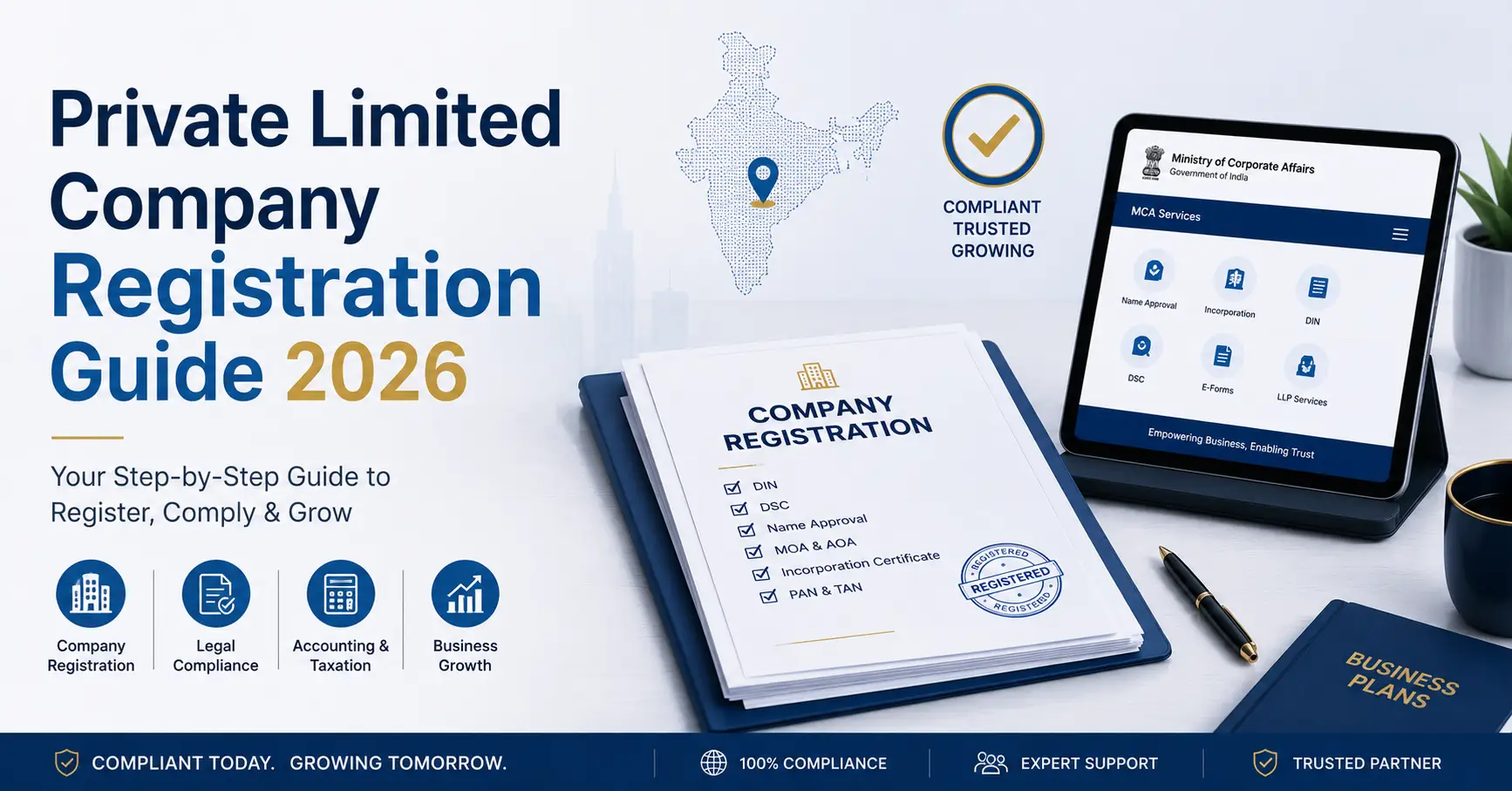
Whether you are an entrepreneur registering your first company or a foreign investor looking to establish a presence in India, this detailed guide covers everything you need to know about private limited company registration in India in 2026 – the process, documents required, fees, timelines, compliance obligations, and much more.
Let us get started.
1. What Is a Private Limited Company?
A Private Limited Company is a type of business entity registered under the Companies Act, 2013, governed and regulated by the Ministry of Corporate Affairs (MCA) in India. It is a separate legal entity from its owners, meaning the company can own property, enter into contracts, sue, and be sued in its own name.
The term “private” means that the company restricts the right to transfer its shares and limits the number of its members to a maximum of 200. It cannot invite the general public to subscribe to its shares – that privilege belongs to Public Limited Companies.
Key Characteristics of a Pvt Ltd Company
- Separate Legal Entity: The company exists independently of its shareholders and directors.
- Limited Liability: Shareholders are only liable up to the amount of their unpaid share capital. Personal assets are protected.
- Perpetual Succession: The company continues to exist even if directors or shareholders change or die.
- Minimum 2 Directors & 2 Shareholders: The company can have a minimum of 2 and a maximum of 200 shareholders, and 2 to 15 directors.
- No Minimum Capital Requirement: There is no mandatory minimum paid-up capital requirement since the Companies (Amendment) Act, 2015.
- Restrictions on Share Transfer: Shares cannot be freely transferred and cannot be offered to the public.
2. Why Choose a Private Limited Company Structure?
With multiple business registration options available in India – such as Sole Proprietorship, Partnership Firm, LLP, OPC, and Public Limited Company – why do most entrepreneurs and investors prefer the Pvt Ltd structure? Here are the most compelling reasons:
a) Limited Liability Protection
Your personal savings, house, and assets are protected. If the company faces debt or legal claims, your liability is limited to only what you have invested in the company.
b) Ease of Raising Funds
A private limited company can raise funds through equity investment, venture capital, angel investors, and bank loans far more easily than a sole proprietorship or partnership. Most institutional investors and VCs exclusively fund registered Pvt Ltd companies.
c) Enhanced Credibility
The “Pvt Ltd” tag adds significant credibility with customers, suppliers, banks, and potential partners. It signals that the business is formally structured, regulated, and compliant.
d) Tax Efficiency
Private limited companies in India are taxed at a flat corporate tax rate (currently 22% for domestic companies under the new regime, and 15% for new manufacturing companies). This is often more tax-efficient compared to individual income tax slabs for high-income businesses.
e) ESOP & Talent Acquisition
Pvt Ltd companies can issue Employee Stock Options (ESOPs), which is a powerful tool to attract and retain top talent – something a sole proprietor or partnership cannot do.
f) Perpetual Existence
Unlike a proprietorship that dissolves upon the owner’s death or incapacity, a Pvt Ltd company continues to exist regardless of ownership changes.
g) Government Schemes & Startup Recognition
Registered Pvt Ltd companies are eligible for DPIIT Startup India recognition, government tenders, production-linked incentive (PLI) schemes, and various MSME benefits that are unavailable to unregistered businesses.
3. Eligibility Criteria for Private Limited Company Registration in India
Before you begin the company registration process, make sure you meet the following requirements:
| Criteria | Requirement |
| Minimum Directors | 2 (at least one must be an Indian resident) |
| Maximum Directors | 15 |
| Minimum Shareholders | 2 |
| Maximum Shareholders | 200 |
| Minimum Paid-up Capital | No minimum (₹1 is technically sufficient) |
| Registered Office | Must have a registered address in India |
| Directors’ Age | Minimum 18 years |
| DIN (Director Identification Number) | All directors must have a valid DIN |
| DSC (Digital Signature Certificate) | Required for all proposed directors |
Note for Foreign Nationals and NRIs: Foreign nationals can be directors and shareholders in an Indian Pvt Ltd company. However, at least one director must be a resident of India (i.e., someone who has stayed in India for at least 182 days during the preceding financial year).
4. Documents Required for Private Limited Company Registration
Gathering the right documents in advance is the most important step to avoid delays. Here is a comprehensive list of documents required for pvt ltd company registration:
For Directors and Shareholders (Indian Nationals)
- PAN Card (mandatory)
- Aadhaar Card
- Passport-size photograph
- Address proof – any one of: Voter ID / Driving Licence / Passport
- Residential proof – any one of: Bank statement (not older than 2 months) / Electricity bill / Telephone bill / Mobile bill
For Directors and Shareholders (Foreign Nationals / NRIs)
- Passport (notarised and apostilled)
- Address proof from country of residence (notarised and apostilled)
- Bank statement or utility bill as residential proof
For Registered Office Address
- If owned: Electricity bill or property tax receipt (not older than 2 months)
- If rented: Rent agreement + NOC (No Objection Certificate) from the property owner
- Any recent utility bill of the premises
Additional Documents
- Proposed company name (with 2–3 alternatives)
- Proposed business activity / Nature of business (in brief)
- Memorandum of Association (MoA) – drafted during registration
- Articles of Association (AoA) – drafted during registration
Pro Tip: All documents submitted to the MCA portal must be self-attested. For NRI/foreign directors, documents must be notarised and apostilled by the relevant authority in their country of residence.
5. Step-by-Step Private Limited Company Registration Process in India (2026)
The private limited company registration process in India is handled entirely online through the MCA21 portal (mca.gov.in). Here is the complete step-by-step process:
Step 1: Obtain Digital Signature Certificates (DSC)
Every proposed director must obtain a Class 3 Digital Signature Certificate (DSC) from a government-authorised certifying authority. The DSC is used to digitally sign all documents submitted to the MCA portal. This typically takes 1–2 working days and costs between ₹800–₹2,000 per director.
Step 2: Apply for Director Identification Number (DIN)
Each proposed director requires a unique DIN issued by the MCA. For new companies, the DIN is applied for within the SPICe+ form itself (see Step 4), so a separate application is no longer needed for up to three directors. For more than three directors, DIN must be obtained separately via Form DIR-3.
Step 3: Name Reservation via RUN (Reserve Unique Name)
Before filing for incorporation, you need to reserve your company name. This is done through the RUN (Reserve Unique Name) service on the MCA portal, or it can be included directly in the SPICe+ form.
Tips for choosing a company name:
- The name must end with “Private Limited”
- It should be unique and not identical or similar to an existing company or trademark
- It should not include prohibited words (e.g., “Government”, “National”, “Bank” without prior approval)
- Prepare 2–3 alternative names in order of preference
Step 4: File the SPICe+ Form (Simplified Proforma for Incorporating Company Electronically)
The SPICe+ Form is a single integrated form that handles multiple registration tasks at once. Filing SPICe+ accomplishes the following in one go:
- Company Incorporation with the ROC (Registrar of Companies)
- DIN allotment for up to 3 directors
- PAN and TAN allotment for the company
- EPFO (Employee Provident Fund) registration
- ESIC (Employee State Insurance) registration
- Opening of a bank account (in select banks)
- GSTIN (if applied for)
- Professional Tax registration (in applicable states)
The SPICe+ form has two parts:
- Part A: Name reservation
- Part B: Incorporation details, DIN, PAN, TAN, and other registrations
Step 5: Draft and Attach MoA and AoA
The Memorandum of Association (MoA) defines the company’s objectives and the scope of its activities. The Articles of Association (AoA) lays down the internal rules and regulations governing the company.
Both documents are drafted as per standard templates available on the MCA portal and are attached to the SPICe+ form. These are prepared using the eMoA (INC-33) and eAoA (INC-34) forms.
Step 6: Pay Government Fees and Submit
Once the SPICe+ form is complete and all documents are uploaded, the applicable government fees are paid online through the MCA portal. The fee structure is based on the authorised share capital of the company (discussed in the next section).
Step 7: Certificate of Incorporation (CoI)
After the ROC processes and approves your application, you will receive the Certificate of Incorporation (CoI) – a legally binding document confirming your company’s existence. The CoI includes the Corporate Identity Number (CIN), the company’s PAN, TAN, and the date of incorporation. This certificate is your company’s birth certificate.
If you need expert support navigating this process, AccounTX offers end-to-end company incorporation services in India – from name reservation to certificate of incorporation and beyond.
6. Private Limited Company Registration Fees in 2026
One of the most common questions from entrepreneurs is: How much does it cost to register a private limited company in India? The total cost includes government fees and professional/service fees.
Government Fees (ROC Fees)
The government fees for company registration depend on the authorised share capital. Below is a simplified overview:
| Authorised Share Capital | Approximate ROC Fee |
| Up to ₹1,00,000 | ₹200 |
| ₹1,00,001 – ₹5,00,000 | ₹300 |
| ₹5,00,001 – ₹10,00,000 | ₹400 |
| ₹10,00,001 – ₹50,00,000 | ₹500 + additional |
Note: Most startups begin with an authorised share capital of ₹1 lakh, which attracts minimal government fees. Additional costs include stamp duty (which varies by state), DSC charges, and professional fees if you hire a CA or CS.
Total Estimated Cost Breakdown (2026)
| Component | Estimated Cost (₹) |
| DSC (per director) × 2 | ₹1,600 – ₹4,000 |
| Government / ROC Fees | ₹200 – ₹2,000 |
| Stamp Duty (state-dependent) | ₹200 – ₹1,500 |
| Professional / CA / CS Fees | ₹3,000 – ₹15,000 |
| Total Estimated Range | ₹5,000 – ₹25,000 |
Beware of extremely low-cost providers online. They often cut corners on compliance, use incorrect documentation, or omit important registrations like PF/ESI, which can cause legal complications later.
7. How Long Does Private Limited Company Registration Take?
With the MCA’s digital-first approach and the SPICe+ integrated form, the typical timeline for private limited company registration in India in 2026 is:
| Stage | Time Required |
| DSC Procurement | 1–2 working days |
| Name Reservation (RUN/SPICe+ Part A) | 1–3 working days |
| SPICe+ Form Preparation & Filing | 1–2 working days |
| ROC Processing & Approval | 3–5 working days |
| Total Estimated Timeline | 7–15 working days |
Delays can occur if documents are incomplete, the proposed company name is rejected, or there is a backlog at the ROC office. Working with an experienced professional significantly reduces the chances of rejections and delays.
8. Post-Registration Compliance Obligations
Registering your company is just the beginning. Once your company is incorporated, you must fulfil ongoing compliance requirements to keep the company in good standing. Ignoring these can lead to penalties, disqualification of directors, and even company strike-off.
Immediate Post-Incorporation Checklist
- Open a dedicated current bank account in the company’s name
- Issue share certificates to all shareholders within 60 days of incorporation
- File Declaration of Commencement of Business (Form INC-20A) within 180 days of incorporation – this is mandatory before transacting any business
- Appoint a statutory auditor within 30 days of incorporation via Form ADT-1
Annual Compliance Requirements
| Compliance | Form | Due Date |
| Annual Return | MGT-7 / MGT-7A | Within 60 days of AGM |
| Financial Statements | AOC-4 | Within 30 days of AGM |
| Director KYC | DIR-3 KYC | 30 September every year |
| Income Tax Return | ITR-6 | 31 October (for companies requiring audit) |
| GST Returns | GSTR-1, GSTR-3B | Monthly / Quarterly |
| TDS Returns | Form 24Q / 26Q | Quarterly |
| Board Meetings | Minutes to be maintained | Minimum 4 per year |
Managing post-registration compliance can be overwhelming for new founders. AccountX provides comprehensive accounting and bookkeeping services tailored for newly incorporated Pvt Ltd companies – ensuring you stay compliant while focusing on growing your business.
If your company plans to hire employees, you will also need to manage payroll, PF, ESI, and professional tax deductions from day one. Our HR and payroll services are designed to handle all of that seamlessly.
9. Common Mistakes to Avoid During Private Limited Company Registration
Many founders rush through the registration process without understanding the implications of each decision. Here are the most common mistakes – and how to avoid them.
1. Choosing a Name That Is Already Trademarked
Even if the ROC approves your company name, you could face legal challenges from trademark holders. Always run a parallel trademark search before finalising your company name.
2. Using a Residential Address Without an NOC
If you are using your home address as the registered office, make sure you have a proper No Objection Certificate from the property owner (especially if you are a tenant). This is a common reason for application rejection.
3. Incorrect Share Capital Structure
Many founders set up incorrect shareholding ratios without thinking through control, future funding rounds, or co-founder exits. Consult a professional to structure the shareholding correctly from the start.
4. Skipping Post-Incorporation Compliances
Not filing INC-20A (Commencement of Business Declaration) or missing the first AGM can attract significant penalties and put your company’s legal standing at risk.
5. Treating Company Funds as Personal Money
This is one of the biggest financial mistakes new company owners make. Always maintain a clear separation between personal and company finances. Open a dedicated current account immediately after incorporation.
6. Not Appointing an Auditor on Time
The law requires you to appoint a statutory auditor within 30 days of incorporation. Failure to do so is a violation of the Companies Act and can attract penalties on directors.
10. Pvt Ltd vs Other Business Structures in India
Choosing the right structure is a critical decision. Here is a quick comparison to help you understand how a Private Limited Company stacks up against other popular business forms:
| Feature | Pvt Ltd Company | LLP | OPC | Sole Proprietorship |
| Separate Legal Entity | Yes | Yes | Yes | No |
| Limited Liability | Yes | Yes | Yes | No |
| Min. Members | 2 | 2 | 1 | 1 |
| Max. Members | 200 | Unlimited | 1 | 1 |
| Equity Funding Possible | Yes | No (typically) | No | No |
| ESOP Issuance | Yes | No | No | No |
| Compliance Level | Moderate–High | Low–Moderate | Moderate | Very Low |
| Suited For | Startups, SMEs, funded businesses | Professionals, service firms | Solo entrepreneurs | Very small businesses |
Bottom line: If you plan to scale your business, raise external funding, hire employees, or build a brand – a Private Limited Company is almost always the right choice.
11. Frequently Asked Questions (FAQs)
Q1. Can a single person register a Private Limited Company?
No. A minimum of two directors and two shareholders are required. If you want to be the sole owner, consider a One Person Company (OPC), which allows a single promoter to incorporate a company.
Q2. Can a foreign national be a director in an Indian Pvt Ltd company?
Yes. Foreign nationals can be directors and shareholders in an Indian private limited company. However, at least one director must be a resident of India. All foreign director documents must be notarised and apostilled.
Q3. Is GST registration mandatory at the time of company registration?
No. GST registration is separate from company incorporation. However, you will need to register for GST if your annual turnover exceeds ₹40 lakh (₹20 lakh for service businesses, or ₹10 lakh in special category states), or if you are engaged in interstate supply.
Q4. What is the difference between authorised capital and paid-up capital?
Authorised capital is the maximum amount of capital the company is permitted to raise through shares. Paid-up capital is the amount actually received from shareholders. A company can start with ₹1 lakh authorised capital and raise it later as the business grows.
Q5. Can I change my company name after registration?
Yes. A company can change its name by passing a special resolution and filing Form INC-24 with the ROC. A new certificate of incorporation is issued after approval.
Q6. What happens if I do not file annual compliance for my Pvt Ltd company?
Non-filing of annual returns (MGT-7) and financial statements (AOC-4) attracts additional fees per day of delay. Persistent non-compliance can lead to the ROC striking off the company from the register, disqualification of directors, and personal liability for outstanding dues.
Q7. Can I register my company online without visiting any office?
Yes. The entire private limited company registration process in India is conducted online through the MCA21 portal. You do not need to physically visit any government office.
Q8. What is the difference between a Pvt Ltd company and a public limited company?
A public limited company can offer its shares to the general public and is listed on a stock exchange. It requires a minimum of 7 shareholders, 3 directors, and stricter compliance. A private limited company has a maximum of 200 shareholders and cannot publicly offer its shares.
12. Conclusion: Is a Private Limited Company Right for You?
If you are serious about building a business that is scalable, fundable, credible, and legally protected – a Private Limited Company is the gold standard in India. It offers the best combination of liability protection, tax efficiency, investment readiness, and operational flexibility for entrepreneurs at every stage.
The private limited company registration process in India is now entirely online and, with the right guidance, can be completed in as little as 7–10 working days. The key is to ensure your documents are in order, your company name is unique, your shareholding structure is well thought out, and your post-incorporation compliances are managed diligently from day one.
At AccounTX, our team of experienced Chartered Accountants and Company Secretaries has helped hundreds of startups, SMEs, and foreign companies register and operate their business in India efficiently and fully compliant. From company incorporation to ongoing accounting, payroll, and taxation – we are your one-stop compliance partner.
Ready to register your Private Limited Company in India? Get in touch with AccounTX today and let us handle the compliance so you can focus on building your business.
Disclaimer
The information provided in this blog post is intended for general informational and educational purposes only. It does not constitute legal, financial, tax, or professional advice. While AccounTX has made every effort to ensure the accuracy and completeness of the information as of the date of publication (2026), laws and regulations are subject to change, and individual circumstances vary significantly.
Readers are strongly advised to consult a qualified Chartered Accountant (CA), Company Secretary (CS), or legal professional before making any business decisions related to company registration, taxation, or compliance. AccounTX shall not be held liable for any losses, damages, or legal consequences arising from reliance on the information contained in this article.